
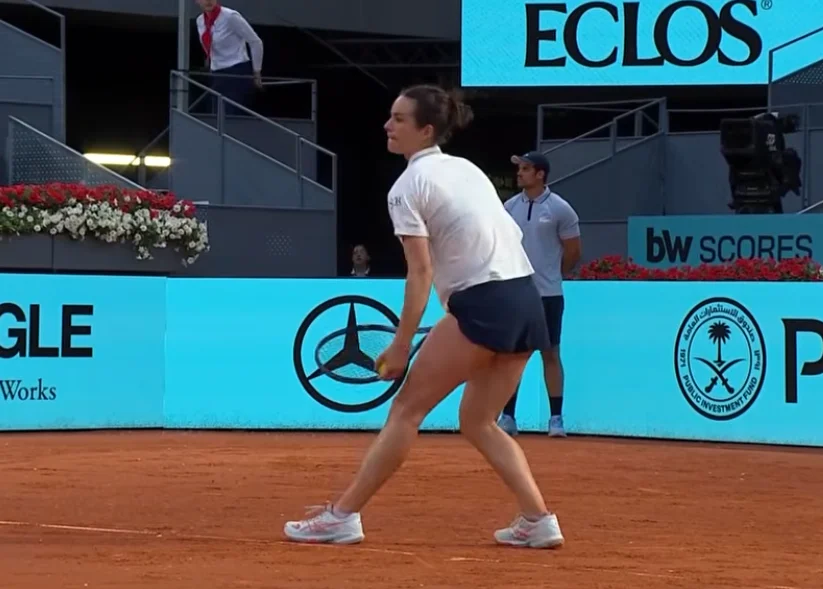
There are comebacks, and then there are returns that feel like a second debut. Lois Boisson arrived in Madrid somewhere in between—no longer the surprise story of Roland Garros, not yet the player she believes she can become again.
On the day, it was not meant to be in the first round of Madrid for France’s No. 1. Boisson was beaten by a fired-up Peyton Stearns, 6–1, 6–3, the USA’s No. 9.
A year ago, she was the name no one expected and everyone remembered. Now, she is back after months of silence, setbacks, and, by her own admission, mistakes that cost her time.
“The last few months have been very difficult –- the most difficult since I started playing tennis,” Boisson said ahead of her return. “I didn’t handle them very well mentally, let’s say.”
That honesty sets the tone. This is not a clean comeback narrative. It is messier than that.
From chaos to breakthrough—and back again
Boisson’s rise never followed a conventional script. Before the results came, there was noise—most notably the now-infamous “deodorant gate” episode with Harriet Dart. It could have derailed her. Instead, it disappeared as quickly as Boisson’s tennis took over.
What followed was one of the defining clay-court runs of last season. A semi-final at Roland Garros. A title in Hamburg. A player suddenly carrying expectations she had never had to process before.
“Perhaps without realising it, it added a kind of stress, a sense of pressure –- something I simply wasn’t used to dealing with –- all that attention surrounding me,” she admitted.
Then came the halt. Injury, first manageable, then not.
“There were quite a few mistakes on the medical side”
Boisson’s absence has not just been long—it has been complicated.
“The two minor injuries I had to my leg weren’t serious,” she explained. “It was mainly this arm injury that was unexpected, to be honest, and difficult to manage.
“There were quite a few mistakes on the medical side. Each time, I was given timings that weren’t realistic… That’s also why there were so many false starts.”
That detail matters. It explains the stop-start nature of her recovery, the frustration, the repeated attempts to come back that never quite held. What looked from the outside like caution was, in reality, miscalculation.
And through it all, the mental toll followed.
Holding on to belief
For all of that, the core has not shifted. Boisson still speaks like a player who expects more from her career—not hopes, expects.
“I’m convinced I have what it takes to achieve great things in tennis,” she said. “I’m happy today to have come out of it stronger and to have come to terms with it all a bit.”
That confidence is not loud. It is steadier now, shaped by what she has had to navigate rather than what she achieved last year.
Her return begins against Peyton Stearns, with the context unavoidable: Roland Garros points to defend, a ranking to protect, and a narrative to rebuild.
Playing again, without pain
Yet for now, the priorities are simpler.
“There’s a really good vibe here,” Boisson said. “Being back on the circuit, at a tournament, I feel it’s giving me something I haven’t had for a while. It’s also helping me to continue with this process of healing.”
“I don’t have any particular expectations. Obviously, I’m going out on court to win, to give it my all.
“But above all, I’ll be absolutely delighted just to be out on court playing tennis and playing without any pain.”
That last line lands differently than it would have a year ago.
Back then, she was chasing a breakthrough. Now, she is reclaiming the ability to compete at all.
Madrid has not defined her return, but it tells us something important—whether the player who stunned Roland Garros can find her way back, this time with a clearer understanding of everything that comes with it.