
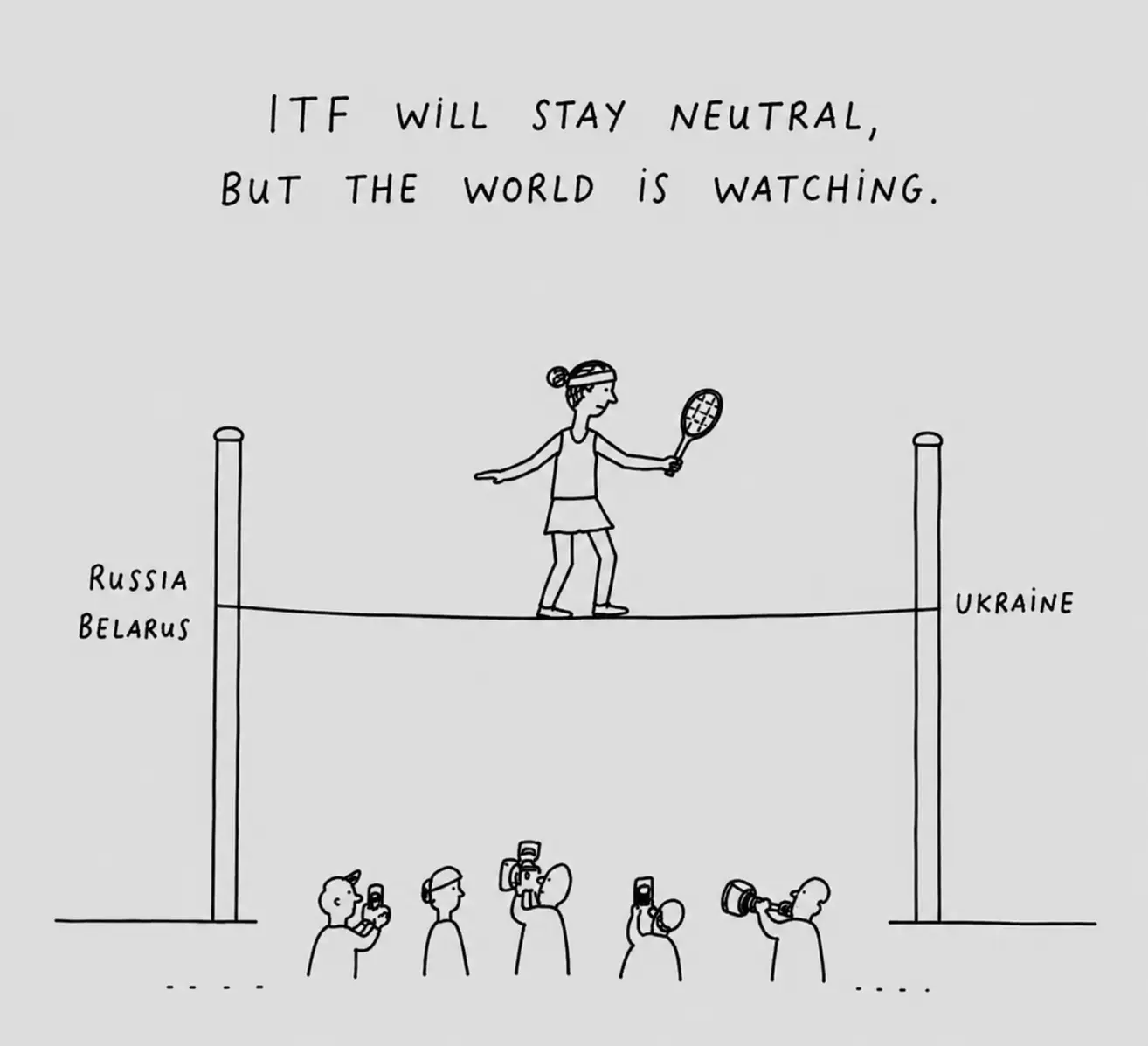
The International Tennis Federation spent most of its existence doing work that rarely generated headlines. Since its formation in Paris in 1913, the organisation has acted as tennis’s rule-maker and administrator — overseeing international competitions, Olympic participation, junior development and the structure beneath the professional tours.
For years, the ITF was easy to overlook beside Wimbledon, the ATP and WTA Tours or the Grand Slams themselves. Fans knew the tournaments and the players far better than the institution sitting behind them.
Then the war in Ukraine forced the federation into a role it had never really prepared for.
Unlike football, where national teams sit at the centre of the sport’s identity, tennis has always lived somewhere between individual ambition and national representation. Players travel independently, hire their own teams and spend most of the year competing for rankings and prize money rather than flags. Yet nationality still matters deeply in tennis. It appears beside names on scoreboards. It defines Davis Cup and Billie Jean King Cup ties. Olympic medals are counted country by country.
When Russia invaded Ukraine in February 2022, tennis suddenly had to work out where those lines actually were.
What the ITF decided after the invasion
On March 1, 2022, the ITF announced the suspension of the Russian Tennis Federation and Belarus Tennis Federation from ITF membership and international team competition.
Its statement read:
“The ITF remains completely united in our condemnation of Russia’s invasion of Ukraine and Belarus’ support of that invasion.”
Russia and Belarus disappeared from the Davis Cup and Billie Jean King Cup. Tournaments scheduled in both countries were removed from the calendar. National flags and anthems vanished from international competition.
But the ITF stopped short of banning individual athletes.
Russian and Belarusian players remained eligible to compete under neutral status. Unlike athletes in some Olympic sports, they were never fully excluded from the ATP and WTA Tours.
At first, the distinction sounded straightforward enough: individuals could continue, nations could not.
In practice, it quickly became more awkward than that.
Why Aryna Sabalenka became the face of the issue
Aryna Sabalenka did not set out to become the symbol of tennis neutrality. She simply became too successful for the sport to avoid the conversation around her.
As she climbed toward the top of women’s tennis in 2023, winning Grand Slams and eventually reaching world No. 1, the Belarusian increasingly found herself carrying political questions into places where tennis players usually discuss second serves and court speed.
The contradiction around her was visible almost everywhere.
Sabalenka would walk into a packed stadium as one of the sport’s headline acts, yet officially appear without a flag or national identification. The neutral designation existed on paper, but nobody watching really experienced her as nationality-free.
At Roland Garros in 2023, the tension became difficult to ignore. Sabalenka faced repeated political questioning about the war and Belarusian president Alexander Lukashenko before skipping a scheduled press conference and later saying she “didn’t feel safe” in that environment.
Even people inside tennis started looking uncertain about where the line should sit. Some journalists argued the questions were unavoidable. Others felt players were being pushed into roles they neither wanted nor understood particularly well.
Sabalenka often looked irritated by the idea that she was expected to explain political realities while simultaneously being told she represented no country at all.
Russian players were living through the same uncertainty
The Russian side of the issue unfolded slightly differently but carried many of the same tensions.
Daniil Medvedev, Andrey Rublev and Karen Khachanov remained among the ATP Tour’s biggest names while existing in a strange sporting halfway house. They were still visible everywhere — seeded at majors, playing night matches on the biggest courts, appearing in sponsorship campaigns — but detached from official national representation.
For Medvedev, the timing was especially odd.
Only months before the invasion, he and Rublev had led Russia to the Davis Cup title in Madrid. The team had been presented as the future of Russian tennis, a deep generation capable of dominating international competition for years.
By spring 2022, Russia was gone from the event completely.
Rublev occasionally appeared less comfortable with the silence surrounding the issue than some of his peers. Shortly after the invasion began, television cameras caught him writing “No war please” on the lens after winning in Dubai.
The moment travelled around the world partly because it did not feel rehearsed. Tennis had already become crowded with carefully managed language by then.
After that, many players seemed to retreat into caution. Some avoided political discussion almost entirely. Others answered briefly and moved on.
Around tournaments, the atmosphere shifted in smaller ways too. Ukrainian players often declined handshakes. Practice schedules occasionally became sensitive. Tournament staff quietly worked around tensions without wanting to publicly acknowledge them.
Most of the time, the tour simply carried on around the discomfort.
Ukrainian players never fully accepted the “neutral” argument
For Ukrainian players, neutrality often sounded cleaner in boardrooms than it looked inside tournaments.
Elina Svitolina repeatedly explained why she would not shake hands with Russian or Belarusian opponents after matches. Her argument was not really about tennis etiquette. It was about refusing to normalise relationships while the war continued at home.
Marta Kostyuk pushed even harder at times.
After losing to Sabalenka at the 2023 French Open and leaving the court without a handshake, Kostyuk was booed by parts of the crowd. Later, she responded bluntly:
“People should honestly be embarrassed.”
She then added that she did not understand how spectators could expect normal sporting rituals while Ukrainians were still dying in the war.
Those moments changed the atmosphere around certain matches. A first-round encounter involving a Ukrainian and Russian player suddenly carried a completely different mood around the grounds. Sometimes the tension was obvious. Sometimes it just sat there quietly through the evening.
Wimbledon exposed how divided tennis had become
The confusion around Wimbledon in 2022 revealed how fractured the sport’s governance structure really was.
The All England Club banned Russian and Belarusian players from that year’s Championships. The ATP and WTA reacted by stripping Wimbledon of ranking points, arguing that athletes were being punished solely because of nationality.
For one season, the sport’s most prestigious tournament effectively became an exhibition in ranking terms.
By 2023, Wimbledon reversed course and allowed neutral athletes to return.
The broader disagreement, though, never really disappeared. Different parts of tennis kept applying different logic to the same issue. Some administrators believed stronger sanctions were necessary. Others argued the tours should remain completely open to individuals regardless of nationality.
The ITF tried to hold a middle ground while the rest of the sport argued around it.
And even now, there does not appear to be universal agreement on whether that middle ground actually exists.
The problem that never really went away
From a governance perspective, the ITF’s position can still be defended. The federation avoided collective bans against individual athletes while sanctioning national federations connected to governments involved in war.
But sport rarely behaves according to legal neatness.
Fans still associate players with countries even without flags beside names. Broadcasters still frame certain matches politically. Press conferences drift in directions nobody particularly enjoys. Handshakes become stories. Silence becomes a story too.
The tours adapted operationally faster than emotionally.
And that may be the part tennis still has not quite worked out.
An awkward backdrop for the ITF’s new era
The timing has also been uncomfortable for the federation itself.
In 2025, member nations approved plans for the ITF to begin operating under the trading name “World Tennis” from 2026 onwards, part of an effort to modernise the organisation’s identity and make its role easier for casual fans to understand.
But while the branding changes, the political questions remain sitting there in full view.
Russian and Belarusian players are still among the sport’s most recognisable names. Ukraine remains at war. International team competitions continue without Russia or Belarus. Every few weeks, another handshake or press conference drags the conversation back into the open again.
Tennis found a way to keep the tours moving after 2022.
That is not the same thing as finding peace with the situation.
Extra sources and reference material
- ATP Tour statement on removal of Wimbledon ranking points (May 20, 2022)
https://www.atptour.com/en/news/atp-wimbledon-points-statement-2022 - Davis Cup honours list and Russia’s 2021 title
https://www.daviscup.com/en/history/honours-roll.aspx - ITF governance and organisational history
https://www.itftennis.com/en/about-us/governance/