
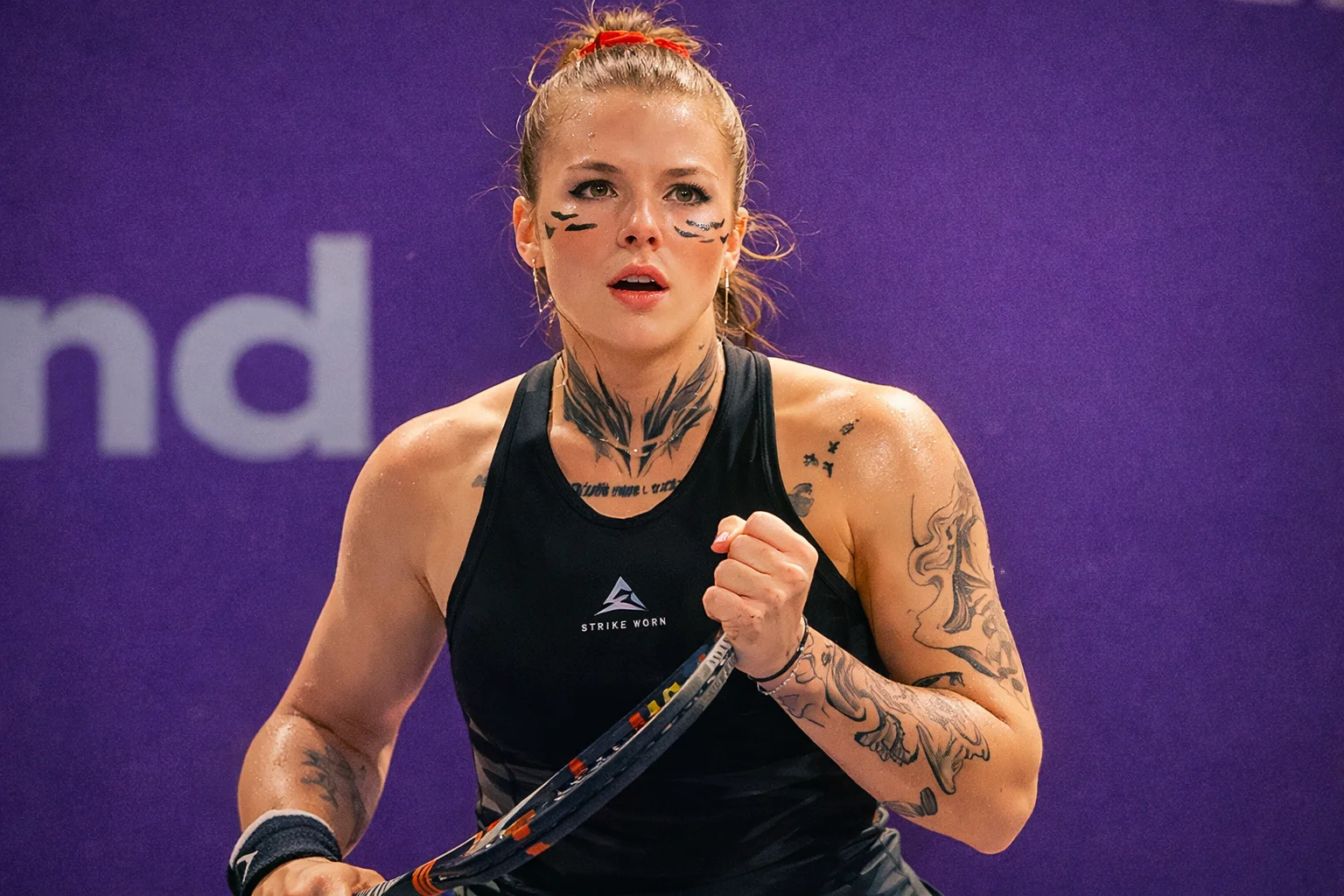
Oleksandra Oliynykova has never looked or sounded like someone trying to blend quietly into the tennis tour.
The Ukrainian, now ranked inside the world’s top 70 after the strongest stretch of her career, has become one of the sport’s most outspoken voices on the war in Ukraine. On court, her game stands out immediately—moonballs, abrupt changes of rhythm, visible emotion and a style deliberately uncomfortable for opponents. Off court, she has become increasingly direct about something far bigger than tennis.
Now she says the WTA has tried to silence that voice.
In a lengthy statement posted to Instagram, Oliynykova claimed she had been threatened with heavy fines and possible disqualification over public comments involving Russian and Belarusian players linked, in her view, to propaganda surrounding the war in Ukraine.
“I began to be threatened with fines”
The 25-year-old says the pressure from the WTA became constant.
“I began to be threatened with fines of tens of thousands of dollars, with disqualification,” she wrote.
According to Oliynykova, conversations with tour representatives repeatedly took place around tournaments—before matches, during events and after they concluded.
“My tournaments became accompanied by constant conversations with WTA representatives, who would come to ‘educate’ me on how I should speak—or rather, how I should stay silent.”
The Ukrainian acknowledged the risks involved in publishing the statement itself.
“Everything I have written now puts me at risk.”
A breakout season alongside growing visibility
The timing matters because Oliynykova’s profile on tour has grown rapidly this season.
She broke into the Top 100 for the first time in 2026, qualified for the Australian Open and pushed her ranking to a career-high No. 66 following strong runs at both WTA and Challenger level.
With that rise came a larger audience.
And Oliynykova used it.
She publicly criticised Aryna Sabalenka over past links to Belarusian president Alexander Lukashenko, condemned Daniil Medvedev for participating in a Gazprom-backed exhibition in Russia and targeted Diana Shnaider over perceived support for Vladimir Putin. In Rouen, she also refused to shake hands with Anna Bondar after Bondar participated in the same exhibition event.
None of it was subtle.
None of it was intended to be.
The St. George ribbon controversy
Further context surrounding Oliynykova’s frustration emerged through Ukrainian Tennis BTU, which highlighted one of the incidents that appears to have escalated tensions between the player and the WTA.
According to the report, Oliynykova was specifically warned after referring publicly to a player who had posted the St. George ribbon symbol on social media—a ribbon widely associated with Russian nationalism and support for the war.
“The WTA arbitrarily interpreted its own rules behind closed doors, ignoring the fact that I myself live as a victim of aggression,” Oliynykova stated.
She also revealed that the situation had already affected her sleep and overall mental well-being.
In additional posts referenced by BTU, Oliynykova explained why she views the symbol as unacceptable within modern European context.
“This symbolism is publicly used by professional tennis players,” she wrote. “Because famous names in tennis have shown that this is acceptable. And that, too, is simply a fact.”
Her argument is not framed as political neutrality.
It is framed as lived experience.
“I will not accept being forced into silence”
Despite the warnings she describes, Oliynykova made clear she has no intention of retreating.
“I am still here. And I will speak,” she wrote. “I will not accept being forced into silence.”
The broader issue remains deeply uncomfortable for tennis.
The WTA and ATP continue to maintain official neutrality regarding Russian and Belarusian participation, allowing players from both countries to compete under neutral status. But for Ukrainian players, neutrality has rarely removed the emotional reality surrounding the war.
Some have handled that quietly.
Others, like Marta Kostyuk, Elina Svitolina and now increasingly Oliynykova, have chosen confrontation instead.
This time, Oliynykova’s confrontation is no longer aimed only at fellow players.
It is aimed directly at the system governing the sport itself.