
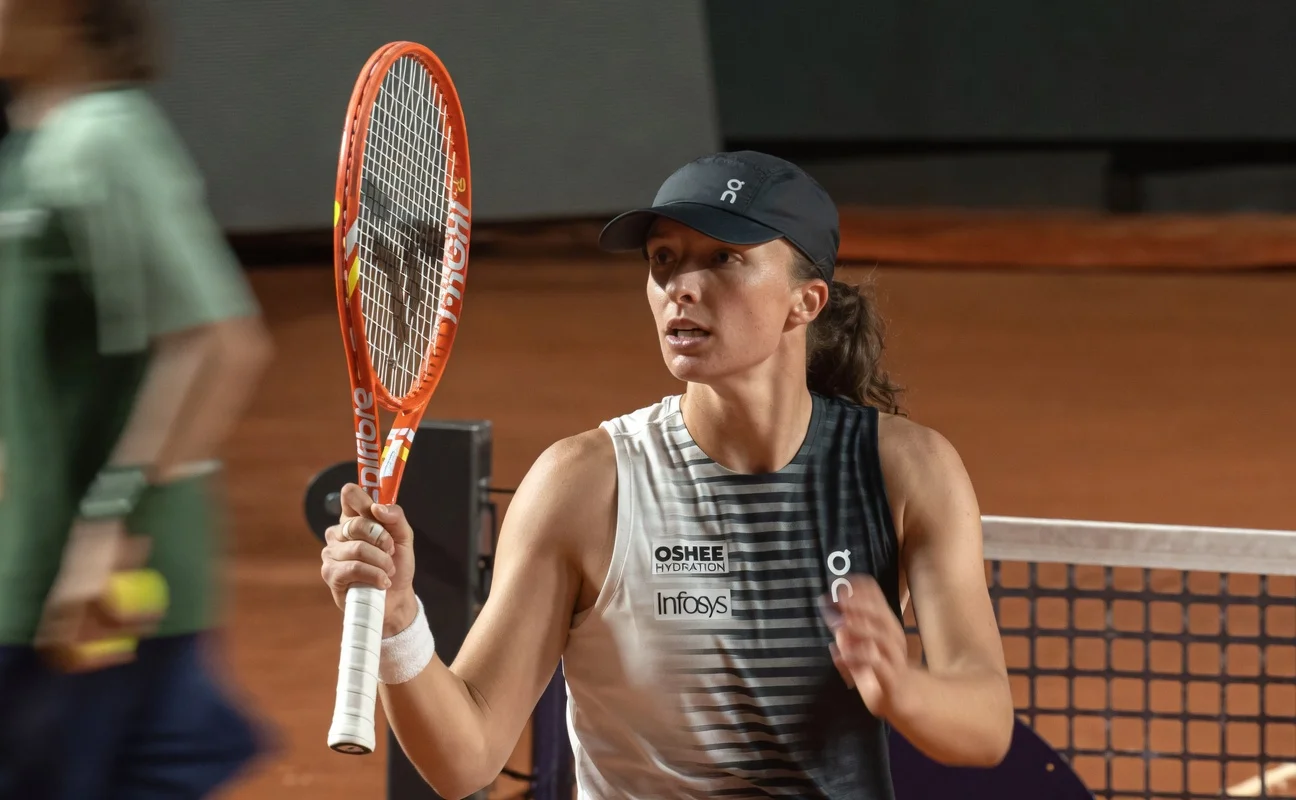
Iga Swiatek is into the third round of Roland Garros, and the scoreboard will not scare anyone on her side of the draw.
6-2, 6-3.
Straight sets. Job done. Another step forward in Paris.
But this was not the same clean demolition she produced against Emerson Jones in the first round. Sara Bejlek did not have the weapons to take the match from Swiatek, but she did enough to make it look less smooth, less automatic, and far more untidy than the score suggests.
Swiatek still won. She still closed the match emphatically, taking the final eighteen points to move through. But the numbers tell a more interesting story than the scoreline alone. Against Jones, Swiatek was ruthless. Against Bejlek, she was superior — but scratchier, looser and more vulnerable on serve.
That may be the most important takeaway. Swiatek was not at full polish. She still won 6-2, 6-3.
Bejlek Could Not Hurt Swiatek Enough, but She Did Disturb Her
Bejlek came into this match as the kind of young clay-court player who can make a favourite work. She is not yet a player who can match Swiatek’s weight of shot over two full sets, but she is not passive either. She competes, she asks questions, and she has enough left-handed awkwardness and clay-court feel to make rhythm less comfortable.
The opening signs made that clear. Swiatek broke early, but Bejlek immediately broke back to get the first set on serve. The Czech talent could not hold that position for long, but it was enough to show that this would not be a simple repeat of the Jones match.
Swiatek went on to build a 5-2 lead in the first set, but even then she made harder work of closing it than she would have liked. She needed a fourth set point before finally sealing the opener 6-2.
That was the match in miniature: Swiatek always ahead, but not always clean losing her service game twice.
The Second Set Stayed Messier Than the Scoreline
The second set followed a similar pattern.
Swiatek opened the door often enough for Bejlek to believe she might complicate things. The problem for Bejlek was that she could not capitalize on serve.
The match became break-heavy, with both players struggling to protect serve. Swiatek was broken twice again in this set, and her own service numbers were not comfortable. Yet whenever the score threatened to become truly awkward, she found another return game, another push, another small burst of pressure.
At 3-1 in the second set, came out the essential truth: Swiatek was not at her best, made a handful of unforced errors, but was not being punished enough.
That is often where the great clay-court players survive imperfect afternoons. They do not always need to be flawless. They just need to make the opponent pay more often than they are made to pay themselves.
Swiatek did exactly that.
The Jones Comparison Shows the Difference
The contrast with Swiatek’s first-round win over Emerson Jones is sharp.
Against Jones, Swiatek’s dominance ratio was 2.36. Against Bejlek, it dropped to 1.35. That is still a winning number, but it is nowhere near the same level of control.
Against Jones, Swiatek won 70 percent of the total points. Against Bejlek, she won 58 percent. Again, good enough. But not overwhelming in the same way.
The biggest difference came in the error column. Swiatek made only 16 unforced errors against Jones. Against Bejlek, that number jumped to 38. Her double faults also rose from one in the first round to six in the second.
That is the real warning hidden inside the win. Swiatek’s return game looked strong again, but her own serve and baseline control were far less tidy than they had been two days earlier.
Swiatek’s Return Game Still Looked Like Paris Business
The good news for Swiatek is that her return game remains an enormous problem for everyone else.
Against Bejlek, she won 62 percent of return points, broke seven times from 11 chances and won 88 percent of her return games. That is a brutal number. It meant that even when her own service games became messy, she could keep taking the match back on return.
Bejlek held just once in eight service games. That tells you everything about the pressure Swiatek applied whenever the Czech player had to start points under her own scoreboard responsibility.
Swiatek also won 71 percent of Bejlek’s second-serve points, almost identical to the 81 percent she won on Jones’ second serve in round one. The return is still biting. The forehand is still doing damage. The ability to turn an opponent’s service game into a survival exercise is still very much there.
Bejlek Had Chances but Not Enough Punch
Bejlek’s problem was not effort. It was finish.
She won 50 percent of the pressure points, matching Swiatek 8-8 in that category. She also broke four times from five chances, which is impressive against a player of Swiatek’s quality.
But she could not build enough behind those moments.
She hit only six winners compared with Swiatek’s 17. She made 24 unforced errors, including 16 on the forehand. Her own serve was under siege all afternoon, and winning just 42 percent of first-serve points made it almost impossible to sustain pressure.
There were flashes where Bejlek made Swiatek look uncomfortable. There were not enough stretches where she made her look genuinely threatened.
That is the line between making a match awkward and making an upset possible.
Swiatek Still Found the Champion’s Finish
For all the mess, Swiatek ended like a champion.
This was not the sparkling first-round version. It was not the ruthless 70-percent-of-points performance against Jones. It was a second-round win with more dents in the paint.
But that is also what makes it useful for Swiatek.
She got pushed into a less comfortable match. She lost control of her serve too often. She sprayed more than she would like. And she still beat a dangerous young clay-courter 6-2, 6-3.
Paris did not get the perfect Swiatek.
It still got enough.
Next up is compatriot Magda Linette, who dismantled Jelena Ostapenko.