

Normally, it takes a while before an Iga Swiatek draw at Roland Garros starts looking uncomfortable. This one managed it almost immediately.
Compared with Aryna Sabalenka, Coco Gauff and Elena Rybakina, Swiatek has landed in the most awkward quarter of the 2026 women’s draw.
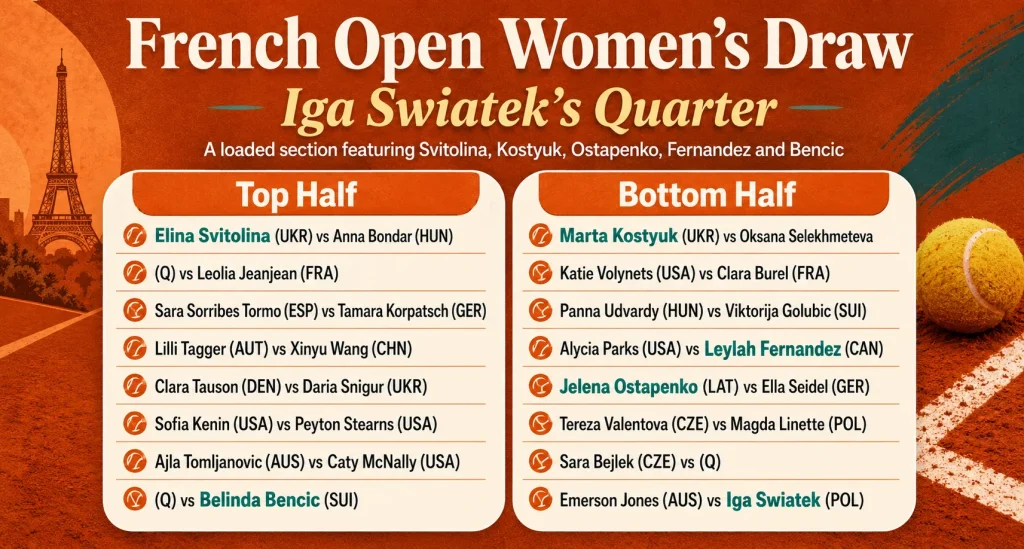
Not because one single opponent changes the whole picture, but because the section is thick with irritation: clay-court grinders, explosive hitters, awkward rhythm-breakers, left-handed angles, dangerous floaters and two Ukrainian dark horses who know exactly how to make Paris feel uncomfortable.
Why Swiatek remains the standard at Roland Garros
She was only 18 when she first conquered Paris in 2020, dismantling Sofia Kenin in straight sets. By 2024, she had already lifted the Coupe Suzanne-Lenglen four times, beating Coco Gauff, Karolina Muchova and Jasmine Paolini in successive finals after that first breakthrough.
That is the astonishing part. In this era of constant turbulence, Swiatek has turned Roland Garros into something close to personal property. Since her first title in 2020, only 2021 and last year stand apart as the exceptions. Everything else has belonged to her.
Her best tennis on these courts still has a suffocating quality: the heavy forehand, the brutal movement, the way she turns neutral rallies into punishment. But this is not a draw that allows her to stroll quietly into the second week.
It asks questions immediately.
Swiatek was handed the quarter no favourite wanted
On paper, Swiatek should still come through this section. In reality, it is the kind of quarter that can make a favourite work before the tournament has properly settled.
Belinda Bencic is nearby, and even with the unusual shape of her comeback, she remains too experienced to be treated as just another name. Clara Tauson brings first-strike weight. Sofia Kenin and Peyton Stearns meet in a match that could produce either Grand Slam nerve or American clay-court bite. Sara Sorribes Tormo can turn any match into a long argument. Xinyu Wang has the clean ball-striking to disrupt rhythm if she finds her range.
That is already a fairly unpleasant opening layer.
Then comes the real problem: this quarter contains several players who do not simply lose politely to reputations.
Jelena Ostapenko is the obvious chaos threat. Her history with Swiatek speaks for itself, but even without that, she would still matter here. Ostapenko does not play with reverence. She plays as if the court is a shooting range and consequences are for other people. Against a dominant clay-courter, that kind of fearless bluntness is both maddening and dangerous.
Leylah Fernandez offers a different kind of discomfort. Her left-handed patterns, speed and competitive edge can make a match feel awkward quickly, especially in Paris. She does not have Ostapenko’s sheer destructive force, but she can change angles, extend points and turn rallies into acts of resistance.
Sara Bejlek should not be dismissed either. She may not carry the same profile as the bigger names in this section, but clay often rewards players who know how to suffer, reset and ask one more question. Bejlek has enough clay-court instinct to be more than a name waiting to be crossed out.
That is what makes Swiatek’s draw feel so striking. It is not one possible blockbuster. It is the accumulation.
Bencic’s experience. Tauson’s power. Kenin’s stubbornness. Stearns’ fight. Fernandez’s lefty bite. Ostapenko’s volatility. Bejlek’s clay-court nuisance value.
For Swiatek, this is not a corridor. It is a crowded room. And here is the catch: that was before even getting to the two Ukrainian names who make this quarter truly dangerous.
Svitolina and Kostyuk give this quarter its dark-horse pulse
If Swiatek is the central figure, Elina Svitolina and Marta Kostyuk give the quarter its emotional and tactical weight.
Svitolina opens against Anna Bondar, and her path has enough room to make a run believable. She remains one of the most dangerous non-top favourites in any Roland Garros draw because her game has always made sense on clay.
The modern Svitolina is not just a retriever. She chooses her moments better now: when to absorb, when to step in, when to turn defence into a controlled strike.
In Paris, that matters even more. Svitolina is not just arriving as a dangerous clay-court player with Rome behind her. She is also married to Gael Monfils, lives in France and will walk into Roland Garros with a crowd ready to adopt every fist pump as its own.
If she moves through the early rounds cleanly, she will not just become an awkward opponent. She will become a story the French can gather around.
Kostyuk brings a sharper, hotter danger. Her opener against Oksana Selekhmeteva may not be the headline match of the section, but Kostyuk’s presence cannot be ignored. She has the athletic base, emotional fire and shot-making ambition to turn a draw upside down.
Her tennis can run hot, and that is both the thrill and the risk. But when she lands first blows and keeps her decision-making sharp, she can make seeded players feel rushed, exposed and uncomfortable.
Together, Svitolina and Kostyuk make this more than a Swiatek watch. Svitolina is the steadier threat: composed, experienced, tactically clear. Kostyuk is the spark: more combustible, more explosive, more capable of tilting the section in one afternoon.
Around them, the danger only deepens.
Ostapenko opens against Ella Seidel, but the opponent often matters less than which version of Ostapenko arrives. Fernandez versus Alycia Parks also has upset energy written through it. Parks brings serve and first-strike violence. Fernandez brings movement, craft and left-handed shape. Whoever survives that match will not be passive.
Bejlek adds one more clay-court obstacle in a quarter already short on soft landings.
So yes, Swiatek remains the player to beat. In Paris, she has earned that status many times over.
But this draw is not kind.
Yet there is one consolation for all Iga Swiatek fans: every other player in the Pole’s section will be thinking exactly the same.