
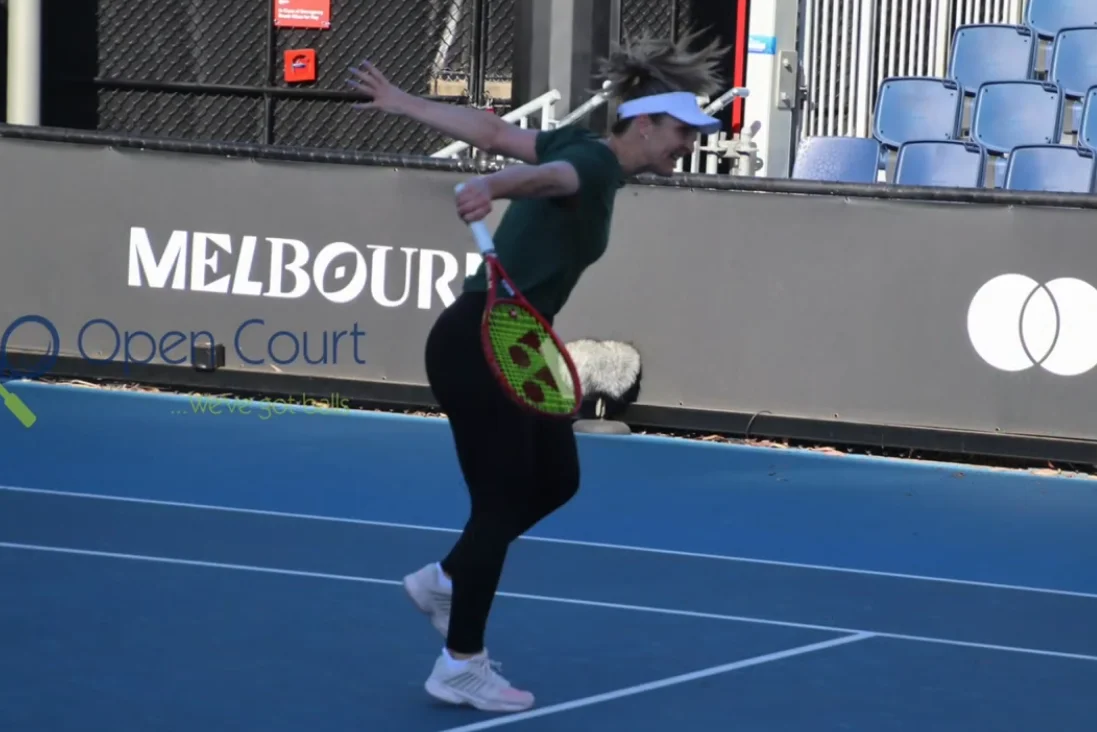
Gabriela Dabrowski’s 2026 season has carried weight beyond the scoreboard. The Canadian doubles specialist has tied her on-court success directly to a broader cause, pledging financial contributions for every game won alongside partner Luisa Stefani in support of the 1in3 Fund.
The initiative is simple in structure but significant in reach: $20 donated per game won. Already, it has generated more than $7,700—fuelled by a strong start to the year that includes a WTA 1000 title in Dubai and semi-final runs at both the Australian Open and the Miami Open.
Performance driving purpose
Dabrowski’s campaign is built on a clear premise: sustained performance leads to sustained impact.
With a target of 600 games won across the season, the projected contribution stands at $12,000. Early results suggest that figure is well within reach. Deep runs at major events have steadily accumulated games, particularly in tightly contested matches where each set adds incremental value.
The Dubai title proved especially productive, with efficient service games and controlled match play maximising output. Similar patterns followed in Melbourne and Miami, where extended runs ensured consistent contributions.
In doubles, the structure of the format itself amplifies the model. Even shorter matches yield multiple games, allowing steady accumulation across tournaments.
A message rooted in reality
The campaign draws its name—and urgency—from a widely cited statistic.
“‘One in three’ refers to the proportion of women and girls over 15 who have experienced physical or sexual violence,” Dabrowski explained. “When I first heard that number, it was shocking. And those are only reported cases—it’s likely higher.”
For her, the issue is not abstract.
“You probably know someone who has experienced some form of violence,” she added.
The initiative also carries a deeper personal motivation following the death of Ugandan athlete Rebecca Cheptegei in 2024—a moment that helped shape the creation of the 1in3 Fund.
“I don’t want her death to be in vain,” Dabrowski said. “I want something positive to come from it—not just from my campaign, but from the whole movement.”
Managing the physical demands
Maintaining that momentum, however, depends on something less visible: physical resilience.
Dabrowski has had to navigate multiple injury concerns, including issues with her shoulder, elbow, knee, and foot. These setbacks forced her withdrawal from Canada’s Billie Jean King Cup qualifying tie in Kazakhstan.
“I just can’t do it right now. I need to take care of my body,” she said. “It was really disappointing because I wanted to be there for the team.”
Daily rehabilitation has become part of her routine as she prepares for the European clay swing—a crucial phase not only for her ranking but for the continuation of the campaign.
Perspective beyond the court
Her season also includes ongoing health monitoring following a breast cancer diagnosis in 2024, discovered during a routine check in Miami.
“I have scans every six months—mammogram and MRI—and so far they’ve been clear,” she said. “I’m very grateful for that.”
That perspective informs the balance she now seeks between performance and sustainability.
Stability in partnership
On court, her partnership with Luisa Stefani has provided the consistency needed to sustain both results and impact. Having previously teamed up in 2021 and 2023, the pair reunited in 2026 with a clearer structure and stronger communication.
“I’m really happy not just with our results, but with how we’ve supported each other,” Dabrowski said. “We’ve played a lot of tough matches and had a lot of good conversations.”
Looking ahead
As the season shifts to clay, the demands will increase—but so too will the opportunities to expand the initiative’s reach.
“For the rest of the year, I hope to stay as healthy as possible, keep playing, ideally win a lot of matches—and do a lot of good along the way,” Dabrowski said.
It is a model built on accumulation, both in sport and in purpose—where each game carries meaning beyond the result.