
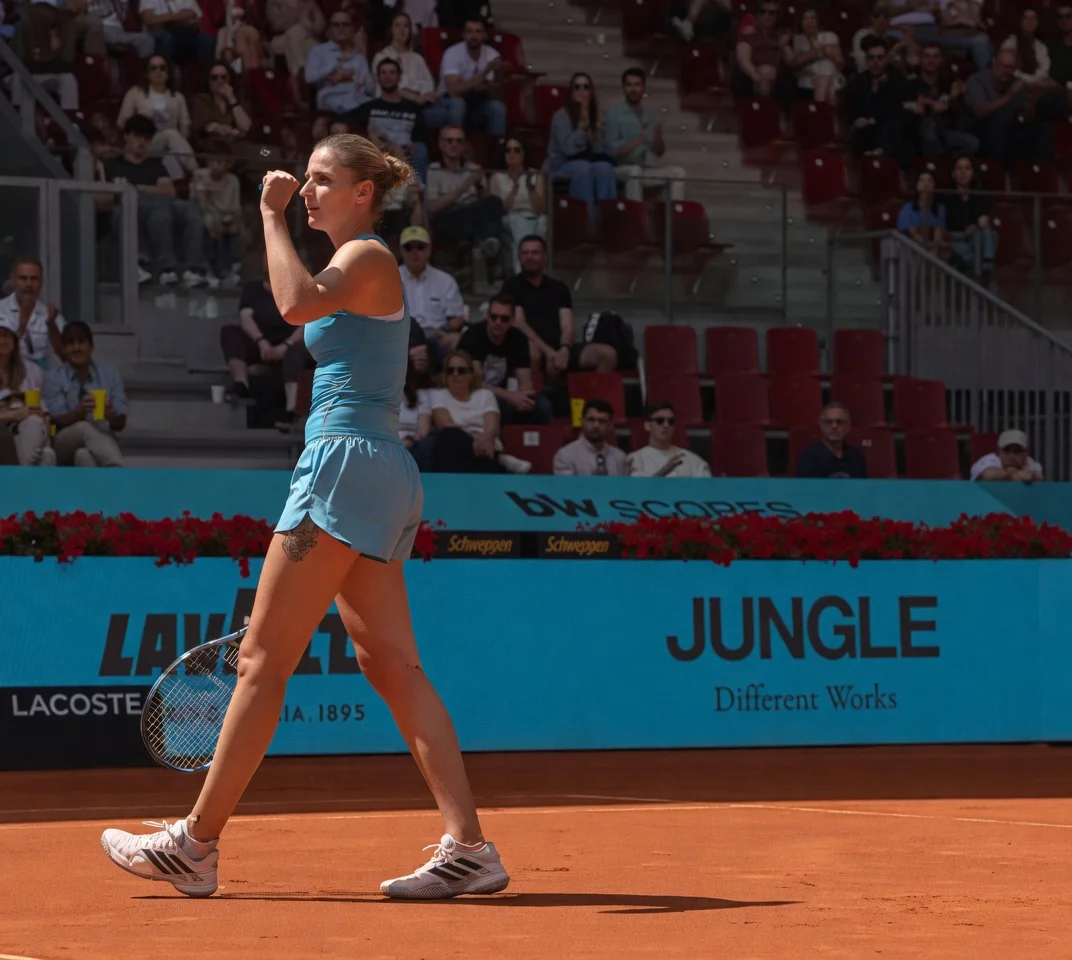
Karolina Pliskova is still a major name to find in a qualifying draw. A former world No. 1, a Wimbledon finalist and a Roland Garros semifinalist in 2017, she arrived in Paris with enough clay-court evidence this spring to make her dangerous: a quarterfinal in Madrid, a run to the last 16 in Rome and useful points gathered after a long climb back.
But Roland Garros qualifying gave her no sentimental passage.
Marina Bassols Ribera beat Pliskova 6-3, 6-2 in the second round of qualifying, taking out the former Paris semifinalist in just 68 minutes and doing it in exactly the kind of slow, heavy conditions Pliskova least enjoys.
Pliskova admitted afterward that she had been “far from winning.”
She also graciously gave Bassols full credit, saying the Spaniard played smart, used higher balls well, gave her nothing for free and pushed forward whenever the chance appeared.
That was the match in miniature: Bassols kept Pliskova moving, denied her rhythm and turned the Czech’s power game into a sequence of awkward recoveries.
Pliskova leads in the first set, then Bassols takes over
The first set briefly looked as if Pliskova might impose herself. Bassols opened with a lost service game, and Pliskova moved ahead 2-0. Even after Bassols pulled it back to 2-2, Pliskova broke again for 3-2, giving herself the kind of scoreboard position she needed.
But that was where the match turned. Bassols broke straight back for 3-3, held for 4-3, then broke again as Pliskova’s serve came under increasing pressure. From 2-3 down, Bassols won four straight games to take the first set 6-3.
Bassols Ribera vs Karolina Pliskova – Set One Stats
| Statistic | Bassols Ribera | Karolina Pliskova |
|---|---|---|
| Dominance Ratio | 1.10 | 0.91 |
| Winners | 9 | 11 |
| Unforced Errors | 9 | 16 |
| Serve Rating | 250 | 160 |
| Aces | 0 | 1 |
| Double Faults | 0 | 5 |
| 1st Serve % | 82% (23/28) | 55% (16/29) |
| 1st Serve Points Won | 48% (11/23) | 69% (11/16) |
| 2nd Serve Points Won | 60% (3/5) | 15% (2/13) |
| Break Points Saved | 0% (0/2) | 50% (3/6) |
| Service Games | 60% (3/5) | 25% (1/4) |
| Ace % | 0% | 3.4% |
| Double Fault % | 0% | 17.2% |
| Return Rating | 241 | 232 |
| 1st Return Points Won | 31% (5/16) | 52% (12/23) |
| 2nd Return Points Won | 85% (11/13) | 40% (2/5) |
| Break Points Won | 50% (3/6) | 100% (2/2) |
| Return Games | 75% (3/4) | 40% (2/5) |
| Pressure Points | 55% (6/11) | 45% (5/11) |
| Service Points | 50% (14/28) | 45% (13/29) |
| Return Points | 55% (16/29) | 50% (14/28) |
| Net Points | 67% (2/3) | 60% (3/5) |
| Total Points | 53% (30/57) | 47% (27/57) |
| Set 1 Duration | 0h37m | |
For Pliskova, the problem was not only that she lost the lead. It was how she lost it. Bassols made her play extra balls, forced her to hit on the move and gradually removed the clean strike zone that Pliskova needs. The former No. 1 was not being blown off the court. She was being dragged out of position and made to work in exactly the wrong areas.
Bassols Builds the Second Set Around Control
The second set was less dramatic, but more decisive. Bassols moved ahead 2-0, and although Pliskova got herself on the board, she never fully changed the direction of the set.
Bassols stretched the lead to 3-1, then 4-2, and the pressure kept returning to Pliskova’s service games. At 5-2, the Spaniard had the match firmly in her hands and closed it out for 6-2, ending Pliskova’s Roland Garros hopes before the main draw.
Bassols Ribera vs Karolina Pliskova – Set Two Stats
| Statistic | Bassols Ribera | Karolina Pliskova |
|---|---|---|
| Dominance Ratio | 1.47 | 0.68 |
| Winners | 10 | 6 |
| Unforced Errors | 9 | 10 |
| Serve Rating | 292 | 221 |
| Aces | 0 | 0 |
| Double Faults | 2 | 2 |
| 1st Serve % | 75% (21/28) | 84% (16/19) |
| 1st Serve Points Won | 76% (16/21) | 56% (9/16) |
| 2nd Serve Points Won | 43% (3/7) | 33% (1/3) |
| Break Points Saved | 100% (6/6) | 33% (1/3) |
| Service Games | 100% (4/4) | 50% (2/4) |
| Ace % | 0% | 0% |
| Double Fault % | 7.1% | 10.5% |
| Return Rating | 228 | 81 |
| 1st Return Points Won | 44% (7/16) | 24% (5/21) |
| 2nd Return Points Won | 67% (2/3) | 57% (4/7) |
| Break Points Won | 67% (2/3) | 0% (0/6) |
| Return Games | 50% (2/4) | 0% (0/4) |
| Pressure Points | 92% (11/12) | 8% (1/12) |
| Service Points | 68% (19/28) | 53% (10/19) |
| Return Points | 47% (9/19) | 32% (9/28) |
| Net Points | 100% (1/1) | – |
| Total Points | 60% (28/47) | 40% (19/47) |
| Set 2 Duration | 0h32m | |
The scoreline reflected the pattern. Pliskova had moments of resistance, but not enough stretches of control. Bassols was steadier, cleaner and better suited to the conditions.
Full match stats show why Bassols had the edge
The full match stats made the difference clear. Bassols finished with a 1.27 dominance ratio, while Pliskova ended at 0.79. Bassols won 58 of the 104 points, taking 56 percent of the total, while Pliskova won 46 points.
The cleaner balance also belonged to Bassols. She hit 19 winners and made 18 unforced errors, while Pliskova produced 17 winners and 26 unforced errors. That gap mattered in a match where Pliskova needed first-strike authority but too often found herself playing from uncomfortable positions.
The serve was even more damaging. Pliskova hit one ace, but she also committed seven double faults, compared with Bassols’ two. Bassols made 79 percent of her first serves, won 50 percent behind her second serve and held in seven of nine service games. Pliskova won only 19 percent of her second-serve points and held in just three of eight service games.
Bassols also dominated the return numbers. She converted five of nine break points, and won 63 percent of her return games.
On pressure points, Bassols led 11-6.
That tells the story neatly: Pliskova had the bigger name, but Bassols had the better answers.
Pliskova Leaves Paris, but Not Without Clay-Court Progress
The defeat is a sharp one because of where it happened and who Pliskova still is. A former world No. 1 failing to reach the Roland Garros main draw is always a headline, especially at a tournament where she once made the semifinals.
Pliskova did not pretend the match was close to turning her way.
“Today was difficult, and I was far from winning,” she said. “The conditions were slow again, so Paris did not disappoint. I would have had to work extremely hard, and I would have had to play really well, which did not happen.”
Yet she did not frame the whole clay season as a failure. Madrid, Linz and Rome all gave her useful evidence after a long climb back.
“Unfortunately, it ended here in a similar way to the last few years,” Pliskova said. “But otherwise I played good matches on clay and gained a lot of points. If someone had told me that beforehand, I probably would have taken it.”
Now the focus shifts quickly to grass, where Pliskova’s game should breathe more easily.
“I feel good. Nothing hurts. I’m ready for the next tournaments,” she said.
Pliskova has Queen’s, Nottingham, Eastbourne and Wimbledon on her schedule, although one warm-up event may still be skipped.
“We still have to sit down with the team,” she said. “For now, I’m entered in Queen’s, Nottingham and Eastbourne, and then Wimbledon. It’s possible I’ll skip one of the preparation tournaments, but for now that’s the plan.”
Source quotes from Marek Bartošík: tenisovysvet.cz
That is the softer landing after a hard Paris exit. Roland Garros exposed the familiar clay-court problem: slow conditions, extra movement, not enough free points and too many shots hit under pressure.
Grass should offer Pliskova more reward for the qualities that once took her to a Wimbledon final.
But Paris gave the final word to Bassols. She did not need Pliskova’s reputation to shrink. She simply made the court bigger, the rallies heavier and the former No. 1’s path much narrower.