
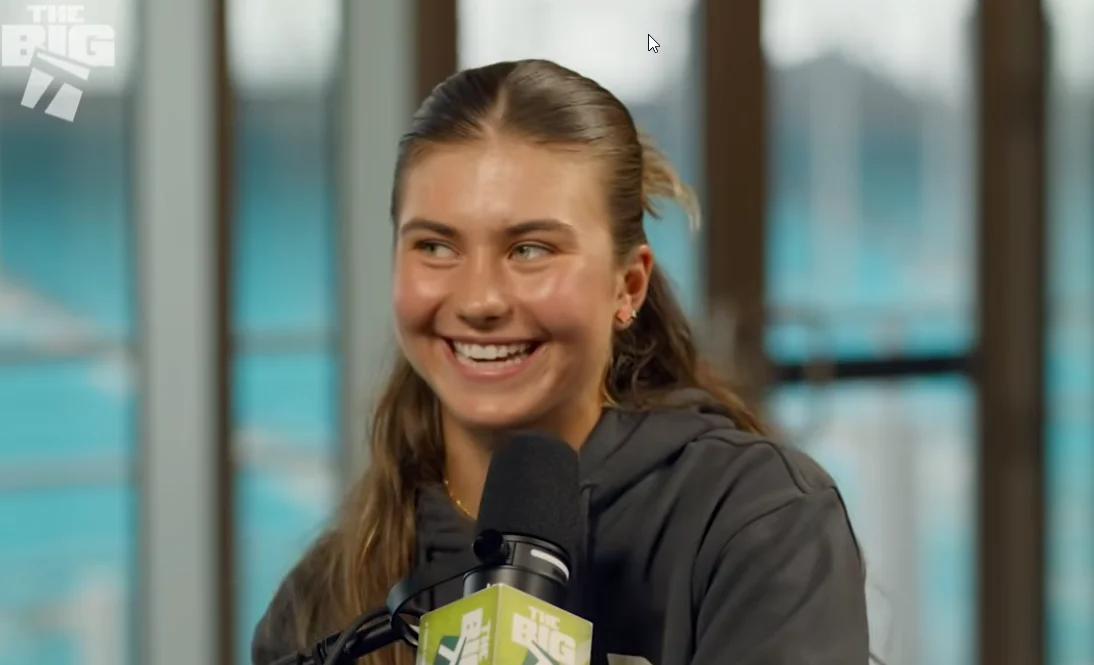

Iva Jovic speaks like a player who has already seen it all. The reality is she is only just getting started.
After this weekend, she is set to climb to a new career-high ranking — another marker of just how quickly her presence on the WTA Tour is solidifying.
At 18, the American has quickly moved from promise to presence on the WTA Tour, backing up her breakthrough 2025 season with a sharp rise into the world’s top 20. Yet behind the results lies something more measured — a player still learning, still adjusting, and deliberately resisting the pull of early hype.
Fast start confirms breakthrough was no accident
Jovic’s ascent first gathered pace with her title run in Guadalajara last year, but her start to 2026 made it clear that it was no one-off.
She reached the semi-finals in Auckland, pushing eventual champion Elina Svitolina, before finishing runner-up in Hobart to Elisabetta Cocciaretto. That form carried into Melbourne, where she reached her first Grand Slam quarter-final, including a notable win over Jasmine Paolini, before falling to world No. 1 Aryna Sabalenka.
It was a demanding stretch — 14 matches across the Australian swing — and one that required a reset.
“I think it was important to go home and rest,” Jovic said on The Big T Podcast. “I played so many matches — I think I had the most time on court of anyone on tour.”
Learning the realities of life on tour
The transition from rising talent to full-time tour player has brought new challenges.
Jovic admitted that managing travel, recovery and physical demands has become just as important as her on-court development.
“I had to recover, get back to practice and deal with a few small illnesses, which I think happens when you’re adjusting to all the travel,” she said. “Now I feel much better and I’m learning how to manage everything — the travel, recovery, and how your body handles the tour.”
That learning curve extends into daily routine — something she is still shaping.
“It’s about routines — figuring out what works for you. Which hotel you like, when you go to the site, when you practise,” she explained. “I’m trying to become a morning person. I don’t know if I like waking up early, but I feel good afterwards.”
There has also been a broader realisation.
“When you’re younger, you think the tour is just the Slams and a few big events like Indian Wells and Miami. But then you realise it never stops — constant travel, last-minute changes. You have to build routines based on what works.”
Handling setbacks and long-term perspective
Recent weeks have brought more mixed results. Jovic exited early in Indian Wells and fell to an in-form Talia Gibson in Miami, a reminder that momentum can shift quickly at this level.
Her response, however, reflects a longer view.
“I think I’m getting better at it,” she said of handling losses. “It’s probably not where it should be yet, but I have a great coach and team helping me.”
Rather than measuring progress purely through wins and losses, she is focusing on development.
“I try not to see matches just as wins or losses, but what I improved and what I didn’t. At the end of the day, I want to be the best player I can be over the next 10–12 years. If that means taking some losses while building my game, that’s OK.”
Still adjusting to the spotlight
Despite her composure in interviews, Jovic insists she is still finding her feet.
“Probably not all the time — I just talk well,” she joked. “I love talking, so don’t let that fool you.”
Away from the court, the reality is less polished.
“I’m a bit all over the place. I lose everything — that’s kind of my thing. I oversleep sometimes, even on match days. I’m still working on becoming a morning person. Hopefully one day I’ll be as responsible and mature as I sound.”
Driven by competition above all else
What remains constant is her relationship with the sport itself.
“I love the competition. It’s not just about winning or losing — it’s how you feel when you compete,” she said. “That feeling in the morning before a match, like a little hole in your stomach — you feel alive.”
Even time away from the court does not dull that instinct.
“If I don’t play for a few weeks, I miss it. Even the toughest matches — it’s the energy, the excitement. Tennis is so personal. It’s just you and another person, like a duel. There’s no time limit, you’re in your own world.”
Competitive roots shaped at home
That mindset, she admits, started long before the tour.
Her family environment was built on constant competition — particularly with her sister.
“My sister Mia — shoutout to her — she just finished the LA Marathon, which is amazing,” Jovic said. “We competed all the time growing up. And Mia, sorry — I cheated a lot! I played dirty. I knew how to push her buttons, and she fell for it every time.”
That same competitive edge now drives her on the biggest stages.
The results may fluctuate, as they often do for a player still adjusting to the demands of the tour, but the trajectory remains clear. Jovic is no longer just a prospect — she is a presence, learning quickly how to stay there.