
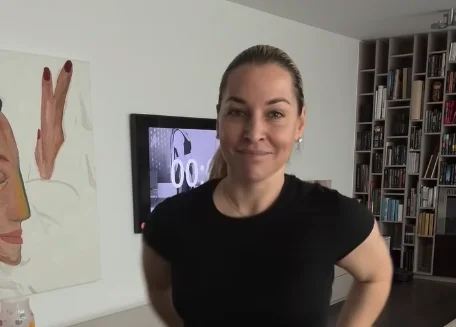

Dominika Cibulkova’s career was never defined by ease. It was shaped instead by sharp turns — moments where belief either faltered or carried her somewhere unexpected.
Speaking on Match Point Canada, the former world No. 4 traced the line between her toughest defeat and her greatest triumph, offering a clear reminder that, at the highest level, mindset often decides what talent alone cannot.
Cibulkova on Facebook: https://www.facebook.com/reel/1231791705230047
From doubt to defining moment
Her crowning achievement came at the 2016 WTA Finals in Singapore — a title few saw coming.
Arriving as the world No. 8, Cibulkova did not feel like a contender. Quite the opposite.
“I felt like an underdog,” she admitted. “It was my first time there, everything felt different.”
That sense of uncertainty showed immediately. In her opening match against world No. 1 Angelique Kerber, nerves took over to the point of physical impact.
“I was so nervous I got cramps in the second set.”
An extra loss followed — to Madison Keys — and with it, a familiar spiral.
“I felt like the worst player in the world. I thought, ‘This is a disaster.’”
Clarity changes everything
The turning point came not through technical adjustment, but through clarity.
Facing Simona Halep, Cibulkova knew exactly what was required: win in straight sets or go home.
“That helped me focus. I told myself, ‘This is the only option.’”
She delivered — 6–4, 7–6 — in a match decided on the edge, including a tense tiebreak and a Hawk-Eye controversy. From there, belief followed performance.
A three-set win over Svetlana Kuznetsova carried her into the final, where Kerber awaited again. This time, the dynamic had changed.
“I knew what to do. I told myself, ‘I will win.’ And I did.”
It remains one of the most striking examples of how quickly momentum — and mindset — can flip at the elite level.
The full WTA Finals 2016 title run
Despite that start, Cibulkova produced one of the most remarkable turnarounds in WTA Finals history:
- Round Robin: lost to Angelique Kerber (7–6, 2–6, 3–6)
- Round Robin: lost to Madison Keys (1–6, 4–6)
- Round Robin: def. Simona Halep (6–4, 7–6)
- Semifinal: def. Svetlana Kuznetsova (1–6, 7–6, 6–4)
- Final: def. Angelique Kerber (6–3, 6–4)
The lesson of Melbourne
That shift, however, had its roots in failure.
Two years earlier, Cibulkova had reached the Australian Open final, defeating the likes of Maria Sharapova and Simona Halep along the way. Yet in the final, Li Na dismantled her 7–6, 6–0.
The explanation, she says now, was entirely mental.
“I didn’t believe in myself at all. Zero.”
Even before stepping onto the court, the match had already slipped away.
“You can lose a match the night before if you don’t think positively.”
The scale of the moment overwhelmed her. Even encouragement from Chris Evert failed to land.
“She tried to help me, but I didn’t believe her.”
It was a harsh lesson — but one that stayed.
“That loss helped me win Singapore in 2016. What you learn from those moments is incredible.”
Life beyond the tour
Since retiring in 2019, Cibulkova’s life has shifted entirely, though not slowed down.
Now a mother of two, she balances family life with running a tennis academy in Bratislava, developing a fitness app, and maintaining a public presence through media and partnerships.
Her transition away from the sport came early, at 30, driven in part by persistent Achilles issues.
“I knew it was time. I wasn’t happy on court anymore.”
A return was never seriously considered.
“I know how hard it was on my body. I couldn’t imagine training five or six hours a day again — especially with children.”
Career finals overview
Cibulkova reached 21 WTA singles finals, winning eight titles across different stages of her career:
| Year | Tournament | Surface | Result |
|---|---|---|---|
| 2008 | Montreal | Hard | Runner-up |
| 2009 | Hobart | Hard | Winner |
| 2009 | Acapulco | Clay | Winner |
| 2010 | Monterrey | Hard | Runner-up |
| 2011 | Moscow | Hard | Runner-up |
| 2012 | Barcelona | Clay | Winner |
| 2013 | Stanford | Hard | Runner-up |
| 2013 | Linz | Hard | Winner |
| 2014 | Australian Open | Hard | Runner-up |
| 2014 | Acapulco | Hard | Winner |
| 2014 | Eastbourne | Grass | Winner |
| 2016 | Katowice | Indoor | Winner |
| 2016 | Madrid | Clay | Runner-up |
| 2016 | Wuhan | Hard | Runner-up |
| 2016 | WTA Finals (Singapore) | Hard | Winner |
| 2017 | Eastbourne | Grass | Runner-up |
| 2018 | Budapest | Indoor | Winner |
Still connected to the game
Tennis, though, has not disappeared completely.
Cibulkova still follows major tournaments and even offers match predictions — with notable success.
“In Indian Wells, I had 12 out of 12 correct picks,” she said with a smile.
It is a quieter connection now, but a meaningful one.
Her story, however, remains rooted in something more enduring: the thin line between doubt and belief — and how crossing it, even once, can define a career.