
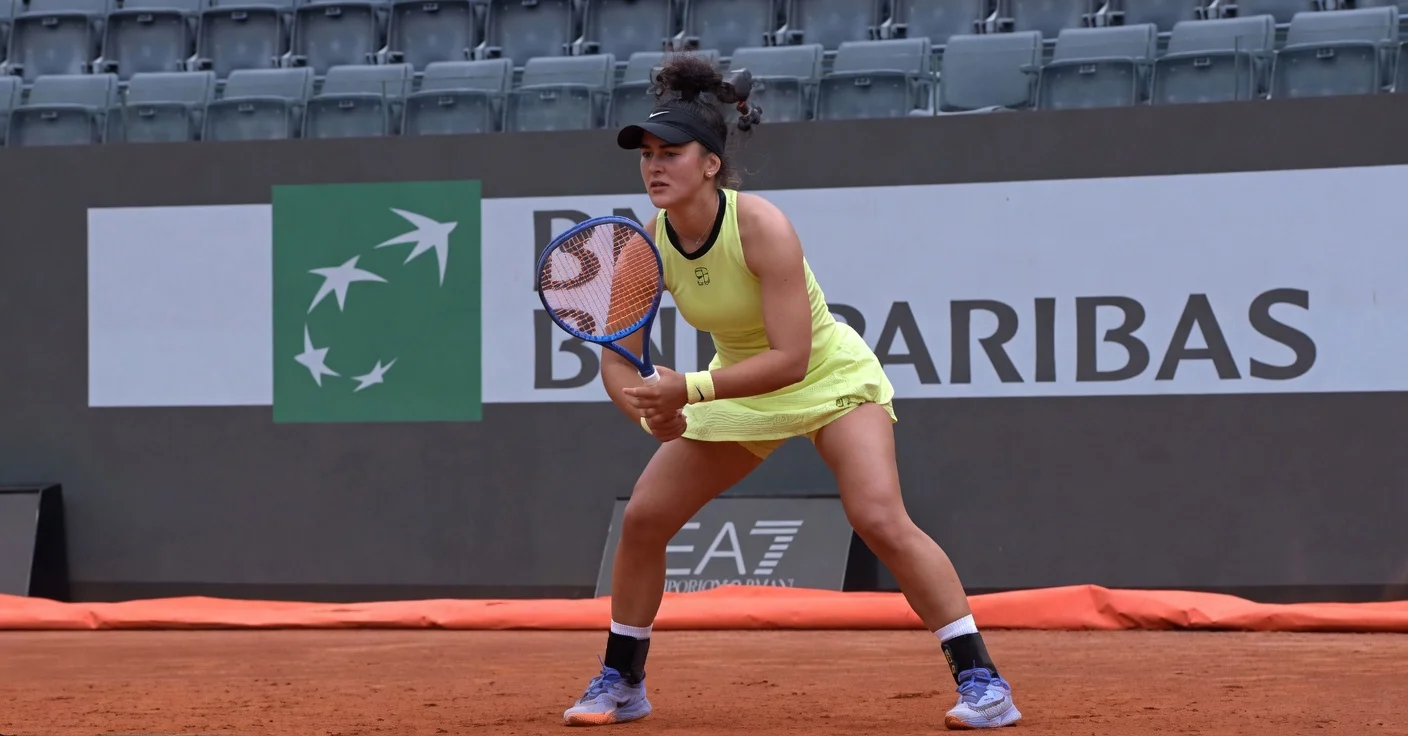
Bianca Andreescu once made comebacks feel like theatre.
The sudden spark. The unpredictable shotmaking. The feeling that if she could only get her body to cooperate for long enough, the rest of tennis might have to deal with her again.
That is why this grass-court return felt so uncomfortable to watch.
Andreescu did not just lose early at the Libema Open in ’s-Hertogenbosch. She was beaten 6-1, 6-2 by defending champion Elise Mertens in barely over an hour, and the scoreline carried a sharper sting because of what comes next. The Canadian arrived in the Netherlands needing matches, rhythm and ranking protection. Instead, she leaves with more points gone, more pressure before Wimbledon qualifying, and more evidence that the road back to the top level is still refusing to straighten out.
For a former US Open champion still trying to rebuild, this was not the grass-court lift she needed.
Mertens Gives Andreescu No Time to Settle
This was a cruel opening assignment.
Mertens was not only the third seed. She was also the defending champion, a player who understands how to move efficiently on grass, keep rallies tidy and make an opponent feel rushed without needing to overplay.
Andreescu needed time.
Mertens gave her none.
The Belgian controlled the match from the start, served with authority and never faced a break point. That last detail says plenty. Andreescu’s game has always needed little windows of disruption — a return game that turns messy, a sudden change of pace, a chance to make the match feel less orderly. Mertens shut those windows before they could open.
Andreescu won only three games. Mertens won 80 percent of her service points. Andreescu managed only 50 percent behind her own serve.
For a player returning to grass and searching for confidence, it was the kind of match that gives you almost nothing to hold.
Ranking Damage Arrives at the Worst Time
The defeat also hurts because Andreescu had points to defend.
She was runner-up at ’s-Hertogenbosch last year, a result that had given her ranking some useful support. This time, a first-round exit means that support disappears quickly. Andreescu is expected to fall at least 17 places, dropping toward No. 175 by the end of the tournament.
That number changes the feeling around her grass season.
It is not only about one poor match. It is about access. It is about where she can enter draws. It is about how often she has to fight through qualifying instead of arriving with a direct place in the main draw.
Andreescu has already had to deal with that reality at Grand Slam level. She fell in Roland Garros qualifying, extending a difficult stretch in which major main draws have become harder to reach. Wimbledon now becomes the next test, and unless something changes through withdrawals or entry movement, she is set for another qualifying attempt.
For a player who once won one of tennis’s biggest titles, that is a stark place to be.
The ITF Route Has Built Matches but Not Yet Momentum
Andreescu has spent parts of this season trying to rebuild through ITF events.
That route can make sense. It gives a player matches, minutes, rhythm and a chance to feel competitive again without immediately running into the deepest WTA fields. Andreescu herself has spoken about understanding why that step was needed.
But the transition back upward remains the difficult part.
Lower-level wins can build confidence, but WTA matches demand more. They demand sharper serving, cleaner first-strike patterns and the ability to handle players who can punish every short ball. Against Mertens, Andreescu looked short of that edge.
The problem is not talent. It never has been.
The problem is accumulation. Injuries interrupt the body. Time away interrupts instinct. Rankings interrupt access. Then every tournament starts to feel like both an opportunity and a rescue mission.
That is a heavy way to play.
Wimbledon Qualifying Now Looms Again
Andreescu’s next major target is likely Wimbledon qualifying.
That sentence alone tells the story. A former Grand Slam champion, still only 25, trying to earn her way into a major main draw through qualifying rounds on grass. It feels wrong in one sense, but it is also the reality her ranking has created.
Her last Grand Slam main-draw appearance came at the 2024 US Open, where she lost in the first round. Since then, the majors have not offered a clear path back. Roland Garros qualifying ended too early. Wimbledon qualifying now becomes another attempt to reopen that door.
Grass can help her if the timing arrives. Andreescu has the hands, the variety and the instinctive shotmaking to make the surface work for her. She can change rhythm, finish at the net, and turn points into something less predictable.
But that version needs confidence and physical trust.
Right now, both still look fragile.
A Comeback Still Looking for Its Shape
Andreescu’s career has never lacked drama.
The problem is that too much of it has come from injuries, interruptions and restarts rather than sustained tennis. The memories of 2019 are still powerful because they showed what she could become when the body, belief and game all lined up at once. Since then, the sport has kept asking her to begin again.
’s-Hertogenbosch was supposed to be another beginning.
Instead, it became another reminder of how hard this road is.
The match against Mertens did not end Andreescu’s grass season, but it did remove the comfort of an encouraging start. Now comes the harder work: regrouping, absorbing the ranking drop, and finding enough competitive sharpness before Wimbledon qualifying begins.
Andreescu does not need people to be reminded of her talent.
Everyone remembers that.
What she needs now is the stretch of matches her career has so rarely allowed her to collect.
Until that happens, the comeback will keep feeling less like a clean return and more like a series of hard restarts.