
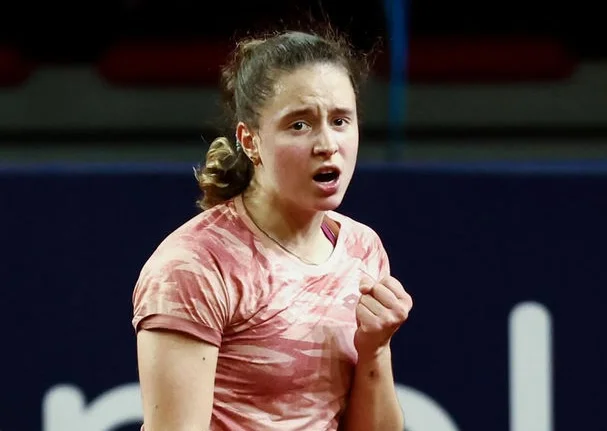
There are finals, and then there are weeks that refuse to behave. Rouen 2026 has delivered the latter — an all-Ukrainian decider on indoor clay, where Marta Kostyuk carries the weight of expectation and Veronika Podrez arrives with nothing but momentum and a growing sense of inevitability.
Podrez began the week in qualifying. She ends it on the brink of a first WTA title.
At 19, ranked outside the top 200, her run has been as brisk as it has been convincing. Sloane Stephens was swept aside with surprising ease, Elisabetta Cocciaretto fell soon after, and Katie Boulter could not disrupt the rhythm. By the time the semi-finals arrived, Podrez was handed a walkover, advancing to her maiden tour-level final without the usual physical toll.
It is the sort of sequence that tends to happen elsewhere — on the ITF circuit, in quieter corners of the calendar — not in a WTA 250 draw with established names.
Podrez, shaped in France, rising for Ukraine
There is a certain symmetry in Podrez’s emergence in Rouen. Born in Ukraine but raised in France, she is a product of both systems — Ukrainian resilience and French technical grounding.
Before this week, her résumé suggested steady progress rather than sudden disruption: multiple ITF titles, a recent W75 trophy, and a ranking climb that hinted at potential without announcing arrival.
Rouen has changed that tone completely.
What stands out is not just the wins, but the manner of them. Podrez has played with clarity rather than caution — stepping inside the court, redirecting pace, and showing little regard for reputations. Against Stephens she dominated from the outset; against Cocciaretto she absorbed and countered; against Boulter she dictated.
There has been no single template — only a growing sense that she is comfortable adapting.
Kostyuk brings order to the occasion
Across the net stands Marta Kostyuk, a player far more familiar with this stage. The Ukrainian No.2 has built her career on sharp baseline aggression and an ability to impose herself early in rallies.
Her route to the final has been comparatively straightforward — efficient rather than dramatic, as befits a player inside the top tier of the tour. Where Podrez has surprised, Kostyuk has simply delivered.
That contrast defines the final.
Kostyuk represents structure, experience, and expectation. Podrez brings momentum, freedom, and a certain unpredictability that can unsettle even the more established names.
A historic note, quietly carried
Beyond the immediate contest, this final carries a broader significance. It marks the first all-Ukrainian WTA final of the Open Era — a detail that feels both historic and, in the current climate, quietly resonant.
Two players from the same nation, forged through different paths, meeting on French soil with a title at stake.
Experience versus momentum
Finals have a way of altering the tempo. Matches that flowed earlier in the week can tighten; players who swung freely can feel the weight of the moment.
For Podrez, the challenge is straightforward in theory and complex in practice: play as she has all week, unburdened by consequence. For Kostyuk, it is about asserting control early, ensuring that the occasion does not drift into uncertainty.
Momentum has carried Podrez this far. Experience suggests Kostyuk should halt it.
Rouen, however, has not followed expectations all week.
A shift in trajectory
Whatever the outcome, Podrez leaves Rouen a different player from the one who arrived. A qualifier no longer, but a finalist with wins over established names and a 62+ ranking rise that will follow.
Kostyuk, meanwhile, has the chance to reinforce her standing — to turn a solid week into a title and maintain the natural order of the tour.
But the intrigue lies elsewhere.
Because in a week that has already bent the script, Veronika Podrez has given herself something far more valuable than a shot at a trophy — she has made herself part of the conversation.