
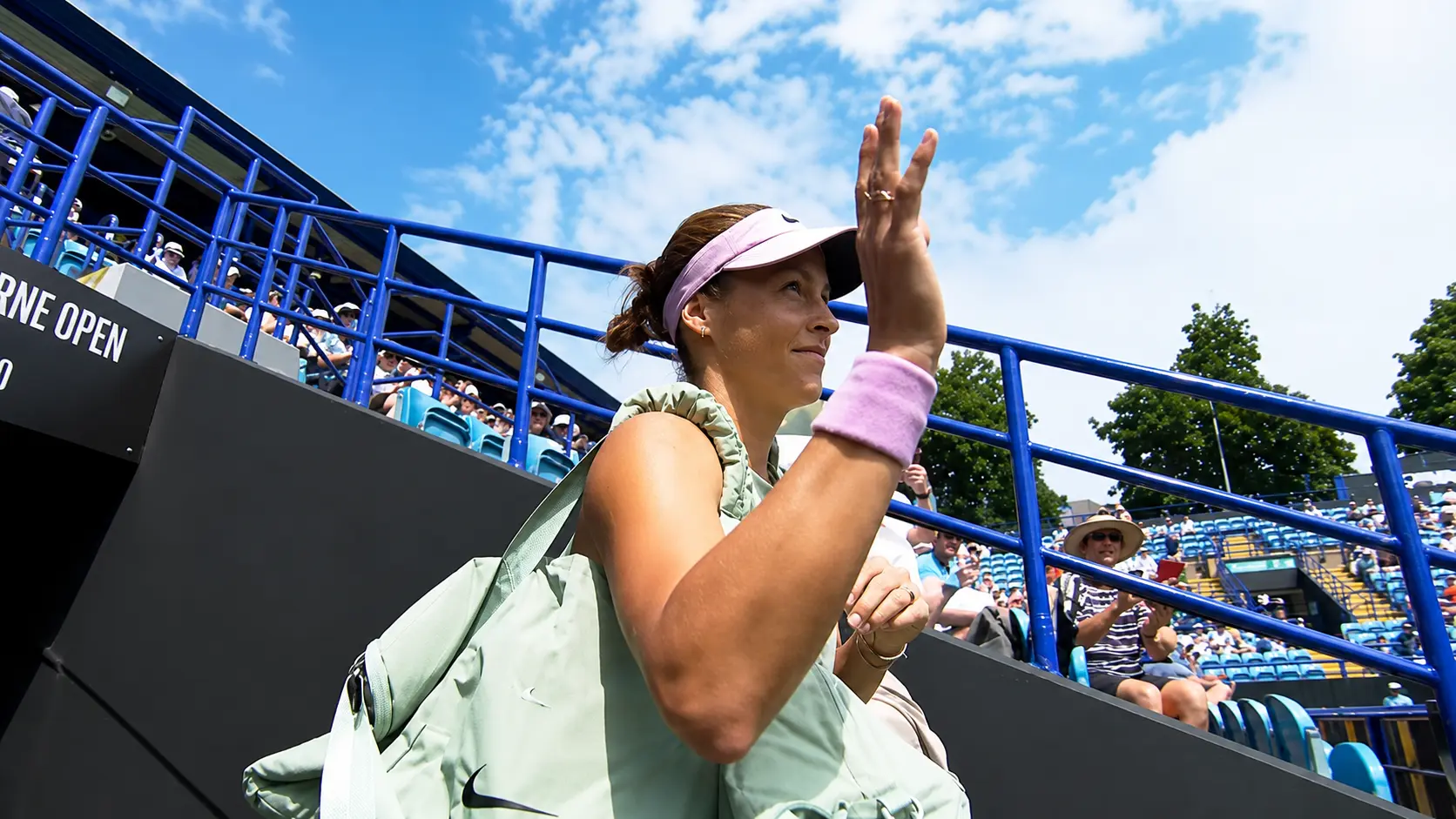
Tatjana Maria does not play grass-court tennis like she is trying to join the modern argument.
She plays as if she has left the argument altogether.
That is why this run deserves more than a routine Eastbourne match report. At 38, with a one-handed backhand, a game full of slices, changes of height, soft hands and sudden little cuts across the ball, Maria has turned this grass swing into one of the smartest stories of the summer.
She is not pretending to be part of the power race. She is not interested in matching the tour’s heaviest hitters shot for shot. She has found something more inconvenient.
She makes them play her match.
That has become one of the stories of this grass season. Maria has come through qualifying draws, beaten seeded players, taken a set from Elena Rybakina, dismissed Jasmine Paolini, and now moved into the Eastbourne semi-finals with a 6-3, 7-5 win over Tereza Valentova.
This is not a small flicker from a veteran having one good day.
It is a very personal pattern.
Since losing in the first round of Roland Garros to Elise Mertens, Maria has turned the grass swing into a reminder of why her game can still be so awkward, so specific, and so hard to solve when the surface rewards low balls, variation and nerve.
Valentova Hit Bigger, but Maria Played the Cleaner Matc
The score against Valentova looked straightforward enough: 6-3, 7-5.
The numbers told a stranger story.
Valentova hit 48 winners. Maria hit 24. Normally, that kind of gap points toward the player controlling the match. Not here. Valentova also made 38 unforced errors. Maria made only nine.
That was the match.
Maria let Valentova swing, but she did not let her settle. She kept the ball low, changed rhythm, protected her service games and forced the Czech to keep taking one more risk.
On grass, that is a dangerous invitation.
Maria finished with a dominance ratio of 1.23 to Valentova’s 0.81. She won 73 points to 63. She also served far better than her opponent, posting a serve rating of 273, hitting eight aces, and winning 75 percent of her first-serve points.
Valentova produced the louder tennis.
Maria produced the smarter match.
A Fast Start, a Wobble, Then the Old Control Returns
Maria began as if she wanted the match on her terms immediately.
She held a long opening game, then broke for 2-0 after Valentova had led 0-40 in her first service game. Maria held for 3-0, then broke again for 4-0. The set looked close to finished.
Then came the wobble.
Valentova broke back for 4-1, held for 4-2, then broke again for 4-3. Suddenly, what had looked like a clean opening set had become a little dangerous. Maria had lost the double-break lead, and Valentova’s bigger ball-striking was starting to count.
But Maria did not let the set turn.
She broke again for 5-3 and then served it out, reaching set point at 40-0 before closing the opener 6-3.
That sequence was typical of the match. Maria lost control for a few minutes, but she never lost the idea. Once Valentova had made her push, Tatjana Maria found the next adjustment.
Maria vs Valentova – Set 1 Stats
| Statistic | Maria | Valentova |
|---|---|---|
| Dominance Ratio | 1.20 | 0.84 |
| Winners | 12 | 25 |
| Unforced Errors | 3 | 18 |
| Serve Rating | 230 | 169 |
| Aces | 5 | 1 |
| Double Faults | 2 | 4 |
| 1st Serve % | 71% (24/34) | 56% (18/32) |
| 1st Serve Points Won | 63% (15/24) | 44% (8/18) |
| 2nd Serve Points Won | 43% (3/7) | 50% (7/14) |
| Break Points Saved | 0% (0/2) | 67% (6/9) |
| Service Games | 60% (3/5) | 25% (1/4) |
| Ace % | 14.7% | 3.1% |
| Double Fault % | 5.9% | 12.5% |
| Return Rating | 214 | 235 |
| 1st Return Points Won | 56% (10/18) | 38% (9/24) |
| 2nd Return Points Won | 50% (7/14) | 57% (4/7) |
| Break Points Won | 33% (3/9) | 100% (2/2) |
| Return Games | 75% (3/4) | 40% (2/5) |
| Pressure Points | 47% (8/17) | 59% (10/17) |
| Service Points | 53% (18/34) | 44% (14/32) |
| Return Points | 56% (18/32) | 47% (16/34) |
| Total Points | 55% (36/66) | 45% (30/66) |
| Set 1 Duration | 0h43m | |
The Second Set Shows Why Maria Is So Difficult on Grass
The second set had a different shape.
Valentova kept holding first. Maria kept answering. It moved from 1-1 to 2-2, then 3-3, 4-4 and 5-5. For a while, the Czech was doing enough to make the set feel level, and Maria was being asked to stay patient.
That is rarely a problem for her.
At 5-5, Maria finally made her move. She broke after a long service game, twice reaching break point before finally taking the lead. Then she served for the match at 6-5.
There was no drama at the end.
Maria reached 40-15 and closed it on match point.
Maria vs Valentova – Set 2 Stats
| Statistic | Maria | Valentova |
|---|---|---|
| Dominance Ratio | 1.44 | 0.69 |
| Winners | 12 | 23 |
| Unforced Errors | 6 | 20 |
| Serve Rating | 306 | 275 |
| Aces | 3 | 2 |
| Double Faults | 1 | 2 |
| 1st Serve % | 64% (21/33) | 65% (26/40) |
| 1st Serve Points Won | 90% (19/21) | 73% (19/26) |
| 2nd Serve Points Won | 50% (7/14) | 54% (7/13) |
| Break Points Saved | – (0/0) | 50% (1/2) |
| Service Games | 100% (6/6) | 83% (5/6) |
| Ace % | 9.1% | 5% |
| Double Fault % | 3% | 5% |
| Return Rating | 140 | 60 |
| 1st Return Points Won | 27% (7/26) | 10% (2/21) |
| 2nd Return Points Won | 46% (6/13) | 50% (7/14) |
| Break Points Won | 50% (1/2) | – (0/0) |
| Return Games | 17% (1/6) | 0% (0/6) |
| Pressure Points | 57% (4/7) | 43% (3/7) |
| Service Points | 76% (25/33) | 65% (26/40) |
| Return Points | 35% (14/40) | 24% (8/33) |
| Total Points | 53% (39/73) | 47% (34/73) |
| Max Points In A Row | 4 | 4 |
| Total Games | 58% (7/12) | 42% (5/12) |
| Set 2 Duration | 0h56m | |
The second set had been tight, but the finish was clean. That is often how her best grass wins feel: uncomfortable for long stretches, then suddenly simple when she has dragged the opponent far enough into her patterns.
The Grass Run Is Becoming Serious
Maria’s recent grass record explains why this Eastbourne semi-final is not a surprise in isolation.
She opened the grass stretch at Birmingham, beating Linda Fruhvirtova 6-0, 6-1 before losing to Rebeka Masarova. Then came Queen’s Club, where she came through qualifying with wins over Yuriko Miyazaki and Kamilla Rakhimova, beat Maria Sakkari 6-3, 6-3, and then took the first set from Rybakina before losing 6-7(4), 7-5, 6-0.
That Rybakina match was important.
Maria did not win it, but she made one of the biggest servers and cleanest grass hitters in the game uncomfortable for two sets. That was a sign.
Nottingham brought more proof. She beat Janice Tjen 6-3, 6-2, then Dayana Yastremska 6-1, 6-2, before losing to Marie Bouzkova in the quarter-finals. Bouzkova would go on to win the title.
Then Eastbourne raised the level again.
Maria beat top seed Jasmine Paolini 6-4, 6-3, then overwhelmed Anastasia Zakharova 6-2, 6-1. Against Zakharova, she posted a dominance ratio of 2.08, hit aces on 13.2 percent of service points, made no double faults, and won 70 percent of second-serve points.
Against Valentova, she backed it up.
That is what makes the run meaningful. It is not one upset. It is a month of awkward grass-court questions, and many opponents have failed to answer them.
Tatjana Maria’s 2026 Grass Results So Far
| Event | Round | Opponent | Result | Score |
|---|---|---|---|---|
| Birmingham 125 | R32 | Linda Fruhvirtova | Win | 6-0, 6-1 |
| Birmingham 125 | R16 | Rebeka Masarova | Loss | 4-6, 3-6 |
| Queen’s Club | Q1 | Yuriko Miyazaki | Win | 6-2, 1-6, 6-2 |
| Queen’s Club | Q2 | Kamilla Rakhimova | Win | 6-4, 6-3 |
| Queen’s Club | R32 | Maria Sakkari | Win | 6-3, 6-3 |
| Queen’s Club | R16 | Elena Rybakina | Loss | 7-6(4), 5-7, 0-6 |
| Nottingham | R32 | Janice Tjen | Win | 6-3, 6-2 |
| Nottingham | R16 | Dayana Yastremska | Win | 6-1, 6-2 |
| Nottingham | QF | Marie Bouzkova | Loss | 5-7, 0-6 |
| Eastbourne | R32 | Jasmine Paolini | Win | 6-4, 6-3 |
| Eastbourne | R16 | Anastasia Zakharova | Win | 6-2, 6-1 |
| Eastbourne | QF | Tereza Valentova | Win | 6-3, 7-5 |
Why Her Game Travels So Well on Grass
Maria’s game has always been unusual, but grass gives it extra bite.
The one-handed backhand stays low. The slice does not sit up. The slower, softer balls become more awkward because opponents have less time to adjust their feet. Her serve is not the biggest on tour, but she uses it intelligently, and this grass swing has shown how effective it can be when she lands enough first serves.
Against Valentova, Maria hit eight aces. Against Paolini, she hit aces on 17.8 percent of service points. Against Tjen, that number was 18.5 percent. She is not simply bunting the ball into play and hoping for chaos. She is getting real value from the serve, then using the next ball to keep opponents away from their preferred strike zones.
That is why her matches can look so strange statistically.
Opponents often hit more winners. They often feel as if they are the ones with the bigger racket. But Maria makes them hit from uncomfortable positions and uncomfortable heights. The errors arrive because the rhythm never quite becomes normal.
Valentova’s 48 winners and 38 unforced errors were a perfect example.
Maria did not stop her from playing brilliant points.
She stopped her from playing enough stable ones.
Tadde, the Veteran Who Still Refuses to Fade
Maria’s profile only adds to the appeal of the run.
Her nickname is Tadde.
She was born on August 8, 1987. She turned professional in 2001. She is 172 centimetres tall, right-handed, and still one of the few players on tour using a one-handed backhand in singles. Her husband, Charles-Edouard Maria, is also her coach.
Her career has been long, full and stubbornly individual.
She has won four WTA singles titles, one WTA Challenger title and 19 ITF singles titles. She has earned more than $6.6 million in prize money. Her career singles record sits above 700 wins. Her peak ranking came at No. 36 in July 2025.
Those numbers matter because they show scale.
Maria is not a novelty act. She is not a charming throwback who occasionally irritates a seed. She is a professional with a long career, a defined tennis identity and a game that still has enough craft to trouble elite opposition when the conditions suit her.
Grass suits her.
Eastbourne is proving it again.
The Mertens Loss Is Already a Different Season
The grass run feels even more striking because of how the clay season ended.
At Roland Garros, Maria lost in the first round to Elise Mertens, 7-5, 6-0. There was resistance early, then the match ran away from her. On clay, her craft can still work, but the surface gives opponents more time to reset and strike again.
Grass is different.
Since that Paris exit, Maria has looked like a player who has found oxygen. She has made quarter-finals in Nottingham and Eastbourne, and now she has pushed further at Eastbourne.
Wimbledon Should Be Watching
Maria’s run comes at exactly the right time.
Wimbledon is close, and there are few players outside the obvious title favourites who can make a first week more uncomfortable than Maria. Seeds do not want this kind of match early. Big hitters do not want to spend two hours bending for slices, changing grips, adjusting timing and wondering why the point feels nothing like the previous one.
That is Tatjana Maria’s power.
It is not brute force. It is disruption.
At 38, she is still doing it. On grass, she is not just surviving. She is making younger, higher-ranked players play a version of tennis they would rather avoid.
Tatjana Maria’s grass season is one of the smartest stories of the summer.