
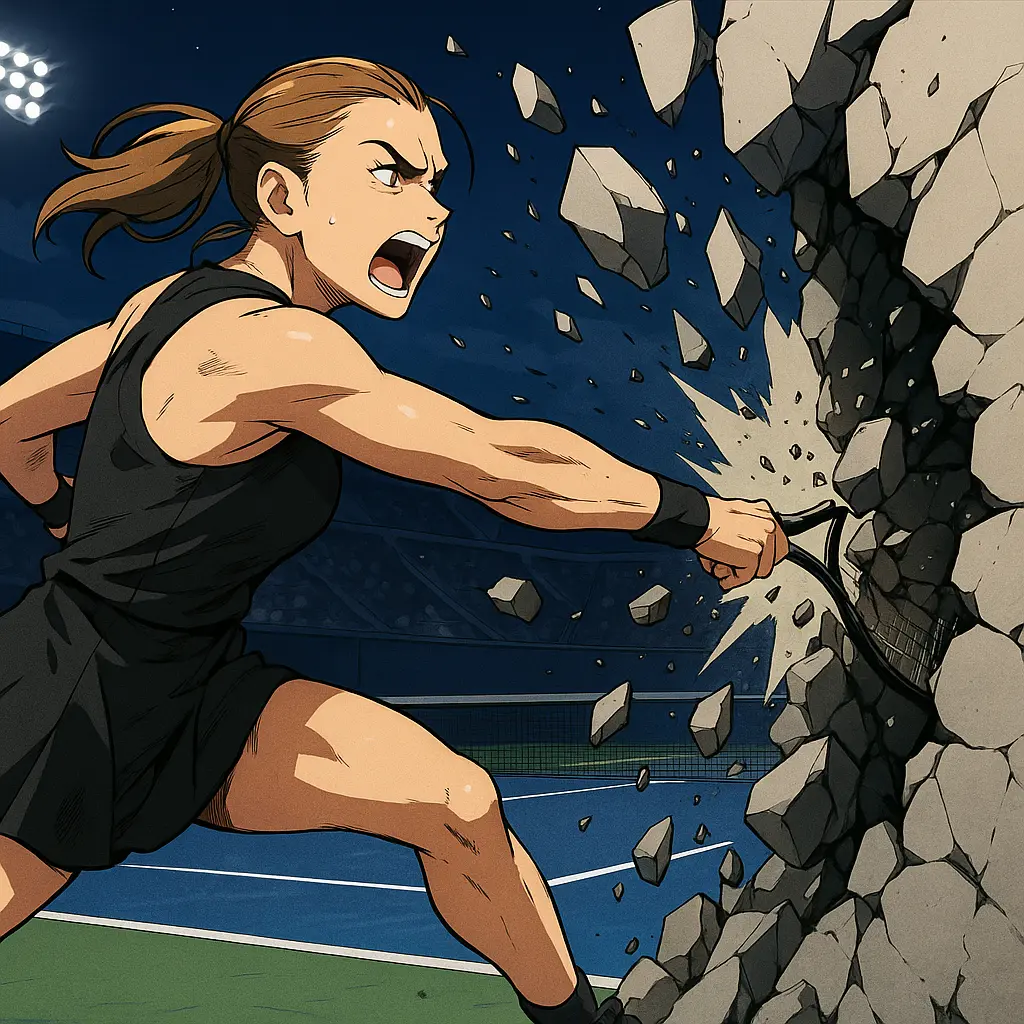

In the land of the brave, Big Science — and its little sister, Big Data — has already delivered its verdict: when sets tighten and walls appear, Aryna Sabalenka breaks them. Across the 2025 season she lost just three tiebreaks, winning 22 to set a record-breaking standard. This year, on another Melbourne afternoon built for nerve, she was at it again.
Aryna Sabalenka does not always make it comfortable, but she almost always makes it through. On a court thick with shifting momentum and raw tension, the world No. 1 survived a ferocious challenge from Anastasia Potapova, edging out a 7-6(4), 7-6(7) victory that tested both her patience and her authority.
What looked, briefly, like routine control turned into a proper Australian Open scrap. Sabalenka had to stare down four set points in a chaotic second set before muscling her way into the fourth round for the sixth consecutive year, reinforcing her reputation as the last woman standing when disorder takes hold.
Sabalenka Holds Her Nerve in a First-Set Tightrope
Sabalenka knew the danger. Potapova arrived buoyed by a surprise win over Emma Raducanu and armed with the kind of flat, early-ball aggression that can disrupt even the heaviest hitters. The top seed struck first, breaking immediately to move 2-0 ahead, her depth and pace forcing rushed replies.
Potapova refused to yield. She broke straight back and steadied the contest, dragging Sabalenka into longer exchanges and denying her clean looks on return. Opportunities were scarce from there, but pressure simmered beneath the surface, particularly on the Russian’s serve late in the set.
Serving at 5-6, Potapova stared down triple set point at 0-40 and survived them all, pushing the opener into a tiebreak defined by nerve rather than margin. Mini-breaks flew both ways before Sabalenka found clarity at the crucial moment, sealing the breaker 7-4 with a backhand that finally drew separation after more than an hour of attrition.
Sabalenka vs Potapova – Set 1 Stats
| Statistic | Sabalenka | Potapova |
|---|---|---|
| Dominance Ratio | 1.26 | 0.79 |
| Winners | 14 | 10 |
| Unforced Errors | 23 | 14 |
| Serve Rating | 282 | 240 |
| Aces | 1 | 1 |
| Double Faults | 2 | 4 |
| 1st Serve % | 68% (27/40) | 48% (25/52) |
| 1st Serve Points Won | 63% (17/27) | 60% (15/25) |
| 2nd Serve Points Won | 69% (9/13) | 52% (14/27) |
| Break Points Saved | 0% (0/1) | 80% (4/5) |
| Ace % | 2.5% | 1.9% |
| Double Fault % | 5% | 7.7% |
| Return Rating | 125 | 185 |
| 1st Return Points Won | 40% (10/25) | 37% (10/27) |
| 2nd Return Points Won | 48% (13/27) | 31% (4/13) |
| Break Points Won | 20% (1/5) | 100% (1/1) |
| Return Games | 17% (1/6) | 17% (1/6) |
| Pressure Points | 17% (1/6) | 83% (5/6) |
| Service Points | 65% (26/40) | 56% (29/52) |
| Return Points | 44% (23/52) | 35% (14/40) |
| Net Points | 60% (6/10) | 43% (3/7) |
| Total Points | 53% (49/92) | 47% (43/92) |
| Max Points In A Row | 6 | 4 |
| Max Games In A Row | 2 | 2 |
| Set 1 Duration | 1h05m | |
A Four-Game Lead, Four Set Points — and No Escape
If the first set demanded discipline, the second demanded resolve. Sabalenka surged ahead, riding her weight of shot to build a commanding four-game lead. It felt decisive. It was anything but.
Potapova ripped the match open with fearless returning, suddenly stepping inside the baseline and forcing errors from the Belarusian. The crowd sensed it, the tempo lifted, and Sabalenka’s margin evaporated. At one stage, Potapova held four set points, the upset within reach as Sabalenka’s errors mounted.
Yet this is where Sabalenka’s evolution shows. She slowed the moment, trusted her second serve, and refused to blink. Each escape tightened the pressure back onto Potapova, whose first-serve percentage deserted her when it mattered most.
Back in a second tiebreak, the world No. 1 absorbed everything thrown at her and delivered the final blow at 9-7, arms raised more in relief than celebration after two hours and four minutes of sustained tension.
Sabalenka vs Potapova – Set 2 Stats
| Statistic | Sabalenka | Potapova |
|---|---|---|
| Dominance Ratio | 1.18 | 0.85 |
| Winners | 20 | 12 |
| Unforced Errors | 21 | 11 |
| Serve Rating | 248 | 201 |
| Aces | 2 | 1 |
| Double Faults | 0 | 2 |
| 1st Serve % | 78% (36/46) | 49% (19/39) |
| 1st Serve Points Won | 58% (21/36) | 58% (11/19) |
| 2nd Serve Points Won | 60% (6/10) | 45% (9/20) |
| Break Points Saved | 50% (3/6) | 0% (0/3) |
| Ace % | 4.3% | 2.6% |
| Double Fault % | 0% | 5.1% |
| Return Rating | 247 | 182 |
| 1st Return Points Won | 42% (8/19) | 42% (15/36) |
| 2nd Return Points Won | 55% (11/20) | 40% (4/10) |
| Break Points Won | 100% (3/3) | 50% (3/6) |
| Return Games | 50% (3/6) | 50% (3/6) |
| Pressure Points | 67% (6/9) | 33% (3/9) |
| Service Points | 59% (27/46) | 51% (20/39) |
| Return Points | 49% (19/39) | 41% (19/46) |
| Net Points | 89% (8/9) | 60% (3/5) |
| Total Points | 54% (46/85) | 46% (39/85) |
| Match Points Saved | 0 | 0 |
| Max Points In A Row | 10 | 4 |
| Max Games In A Row | 4 | 4 |
| Set 2 Duration | 0h59m | |
What the Numbers Reveal
The stat sheet explains why this match never settled. Sabalenka finished with 34 winners but also 44 unforced errors, a reflection of both her dominance and the turbulence Potapova forced upon her.
A clear edge on serve proved decisive: Sabalenka landed 77% of first serves and won 65% of second-serve points, while Potapova struggled at just 49% on first-serve percentage.
Sabalenka won 54% of total points and posted a Dominance Ratio of 1.20, compared to Potapova’s 0.83, numbers that underline control without comfort.
Net efficiency — 14 of 19 points won — offered a quieter clue to how Sabalenka steadied herself when the baseline became volatile.
The result sends Sabalenka into the fourth round once more, her Grand Slam consistency unbroken and her authority intact.
It was not serene, but it was strong — another reminder that champions are defined less by how they start than by how they survive.
For Sabalenka, tennis paradise is no abstraction — no Big Science.
It is exactly where she is right now.