
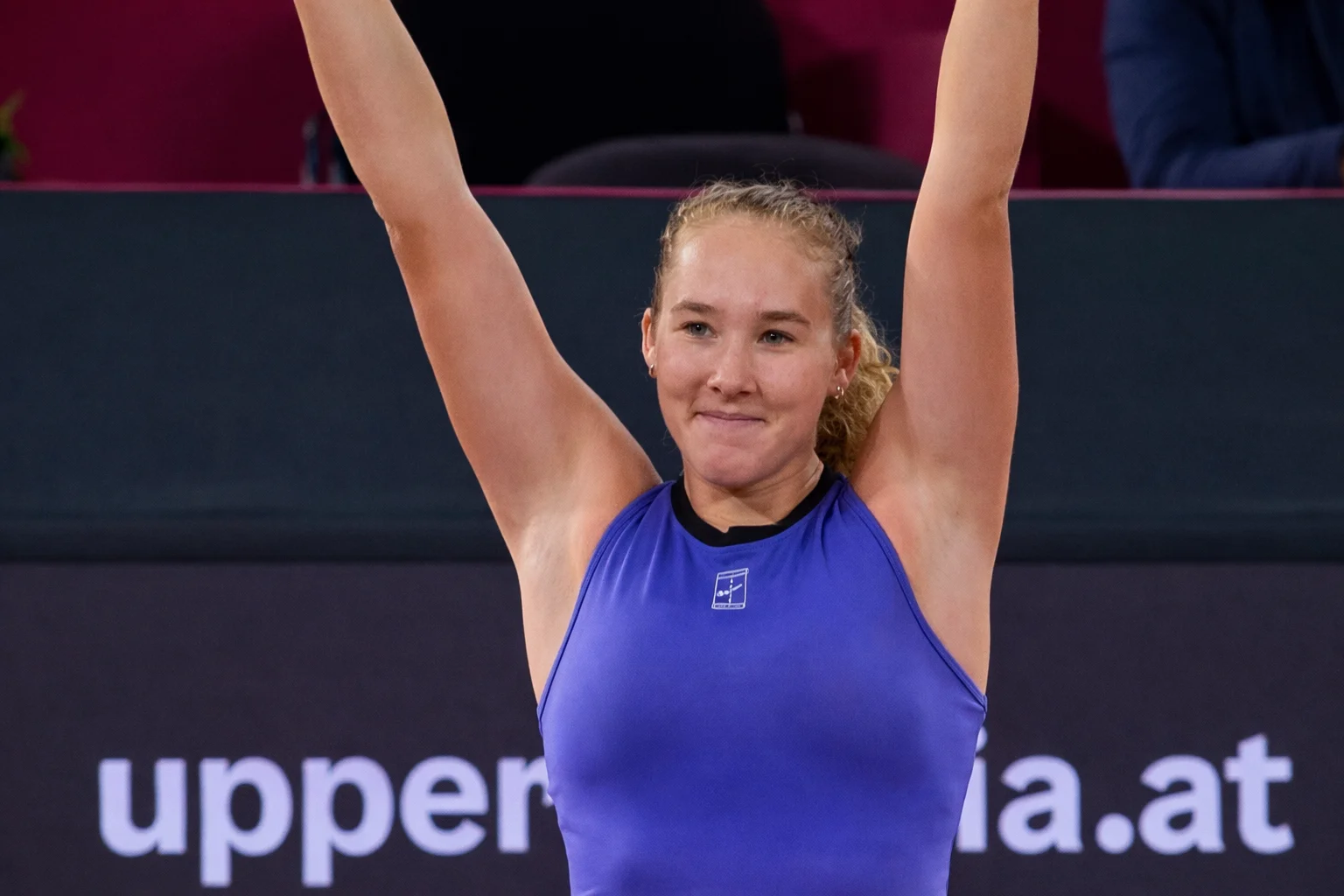
Something has shifted in Mirra Andreeva’s game—and more importantly, in her relationship with it.
In Stuttgart, where the margins are thin and the field unforgiving, the 18-year-old did more than reach another semi-final. She offered a clearer window into the evolution behind her results: a player learning not just how to win matches, but how to enjoy them.
Her comeback victory over Iga Swiatek—3-6, 6-4, 6-3—captured that transition in real time. It was not flawless, nor entirely controlled, but it was revealing.
Learning to stay, not chase
For much of her early rise, Andreeva’s game has been defined by instinct—reactive, emotional, often brilliant. What is emerging now is something steadier beneath it.
Against Swiatek, that balance was tested again. After dropping the opening set and falling 0-2 behind in the decider, the match followed a familiar script. In previous months, that might have tilted away from her.
This time, she recognised the moment.
“I just told myself that I’ve been in these situations before,” she said. “Being down doesn’t really mean anything.”
What followed was not a surge of risk, but a sequence of decisions—five consecutive games built on repetition rather than impulse. The turnaround was less about changing the match than staying in it.
That distinction matters.
Enjoyment as a competitive tool
The most telling change, though, is not tactical. It is emotional.
“Lately, I’ve caught the feeling of how much I enjoy playing,” Andreeva admitted. “I like to feel the ball, the adrenaline, even being a bit nervous.”
For a player still navigating the expectations that come with early success, that clarity is significant. Enjoyment, in this case, is not decorative—it is functional. It allows her to remain present when matches become unstable.
There is still volatility. She acknowledges the flashes of frustration, the emotional spikes that surface when control slips. But the awareness is new.
“The calmer I stay, the better I play.”
It is a simple line, but one that reflects a broader recalibration.
Two versions of the same player
Part of that process has been understanding the split between who she is on court and who she is away from it.
Andreeva has spoken openly about this duality—how competition reshapes behaviour, how adrenaline and pressure distort the version of herself that people see.
“On court, I think that sometimes we’re completely different people,” Andreeva said . “Off the court, we’re completely different people.”
Rather than resisting that contrast, she is learning to work with it. The emotional intensity that once threatened to derail matches is now being framed as part of the job, not a problem to eliminate.
That perspective has given her more room to operate in tight situations—less judgment, more acceptance.
Structure around instinct
Even within matches, the balance between instinct and structure is evolving.
A mid-match exchange with coach Conchita Martínez during the Swiatek win was not pre-planned, but it reflected a growing openness to guidance in key moments. The adjustments themselves were subtle, but the willingness to pause and reset was notable.
At the same time, her natural creativity remains intact. A sliding forehand drop shot—improvised, unpractised—drew one of the reactions of the match.
“I don’t practise those shots,” she said. “I just feel it.”
The difference now is when those instincts are used, not whether they exist.
A selective path beyond singles
That same clarity is shaping her broader schedule.
In doubles, where she formed one of the tour’s most promising young partnerships with Diana Shnaider, Andreeva has taken a step back. The decision to prioritise singles—particularly at Grand Slams—has shifted the structure of that collaboration.
Shnaider, adapting her own schedule, confirmed the partnership will continue selectively, with planned reunions in Madrid and Rome.
It is a pragmatic adjustment—one that reflects Andreeva’s current phase: consolidation.
From breakthrough to belonging
Three years ago in Madrid, she was the wildcard disrupting expectations. Now, she arrives as a top-10 player with titles at both WTA 1000 and 500 level, and with a growing sense of belonging in these stages of tournaments.
Her motivation, she says, remains rooted in those early ambitions—watching top players, imagining herself among them.
“When I play those players now, I remind myself that this is what I wanted.”
That reframing has removed some of the weight from big matches. They are no longer exceptions; they are the point.
The shape of what comes next
As she moved through Stuttgart and towards another meeting with Elena Rybakina, the pattern was clear: not dominance, but development.
Andreeva is still a player in motion—technically, emotionally, structurally. There are fluctuations, unfinished edges, and moments where matches slip before they stabilise.
But there is also something more durable taking shape.
Not just belief, but enjoyment.
Not just instinct, but control.
And increasingly, the sense that both can coexist.