
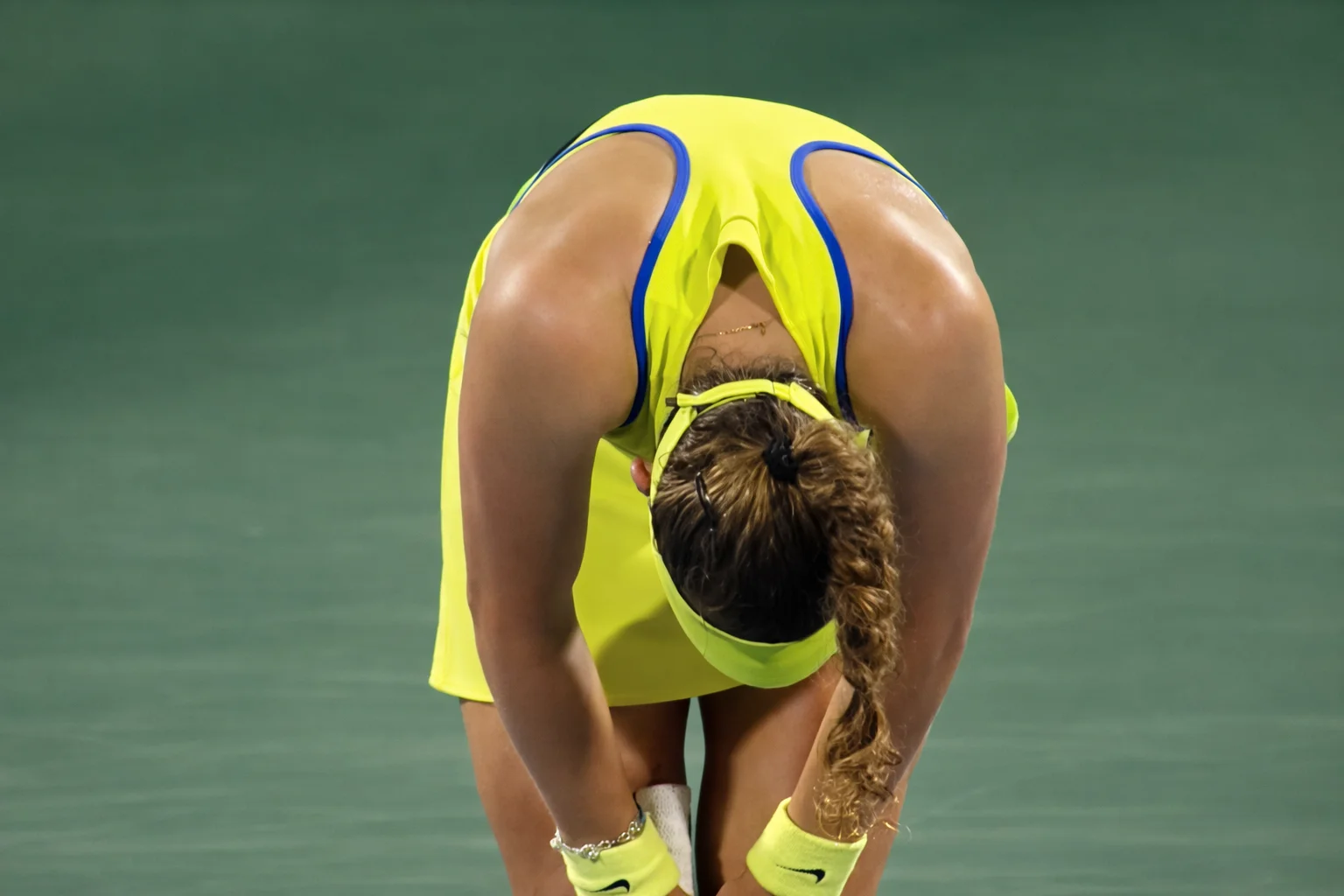

Mirra Andreeva arrives in Linz under a different kind of spotlight. Not for a breakthrough win, but for a moment she would rather take back.
Just days after confirming her late entry into the Upper Austria Ladies Linz, the 18-year-old addressed her outburst in Indian Wells with unusual clarity — and little attempt to soften it.
A reset comes quickly
Andreeva’s decision to play in Linz was made on the fly. An early exit in Miami opened the door, and a late wildcard secured her place in the draw — one that immediately installed her as the top seed.
“I’m grateful to receive a wildcard on such short notice,” she said, via Kurier. “I lost early in Miami and decided quickly to play this week.”
It is a pragmatic move. With no points to defend, Linz offers a clean stretch of matches — something Andreeva has openly prioritised as she builds momentum heading into the clay season.
“Unacceptable — I’m ashamed”
Yet the tennis is only part of the story.
Her campaign in Indian Wells ended with a flashpoint: a thrown racket and verbal abuse directed towards the crowd. The incident drew attention not just for the behaviour itself, but for the stage on which it unfolded.
In Linz, Andreeva did not deflect.
“That’s unacceptable. It shouldn’t happen. I’m ashamed of it,” she said.
The bluntness is notable. At 18, she remains one of the youngest players inside the top 10, and moments like this tend to linger — unless addressed directly. Here, at least, there is no ambiguity in how she views it.
Process over pressure
On court, her focus remains deliberately simple.
“I want to keep improving. That’s my goal. The rest will come.”
It is a familiar line, but in this context, it carries weight. Without ranking points to defend this week, Andreeva has room to recalibrate — to prioritise rhythm over results.
The conditions in Linz, while indoor, still offer a useful bridge into the clay swing.
“I like the conditions. It’s a good start for the clay season,” she noted, even if the surface itself differs from what lies ahead.
There is also a sense of familiarity.
“I played many junior tournaments here,” she added — a small detail, but one that often matters in weeks like these.
Main source of quotes: Austria’s Kurier
A steady rise, briefly interrupted?
Andreeva’s season has, by most measures, been solid.
She opened the year with a title in Adelaide, defeating Victoria Mboko in the final, and followed it with a run to the fourth round at the Australian Open. Since then, results have been consistent, if less headline-grabbing.
Indian Wells brought a third-round exit to Katerina Siniakova — a match she had initially controlled — while in Miami she reached the round of 16, again losing to Mboko in three sets.
Now ranked world No. 10, she remains firmly within the sport’s upper tier.
A week with little to lose — and something to prove
In Linz, the equation is straightforward.
No points to defend. A bye into the round of 16. A draw that places her as the player to beat.
But the subtext runs deeper.
This is less about standings and more about response — to a difficult moment, to the scrutiny that followed, and to the demands of a season that is only beginning to take shape.
For Andreeva, the opportunity is immediate.
The question is how she chooses to use it on clay.