
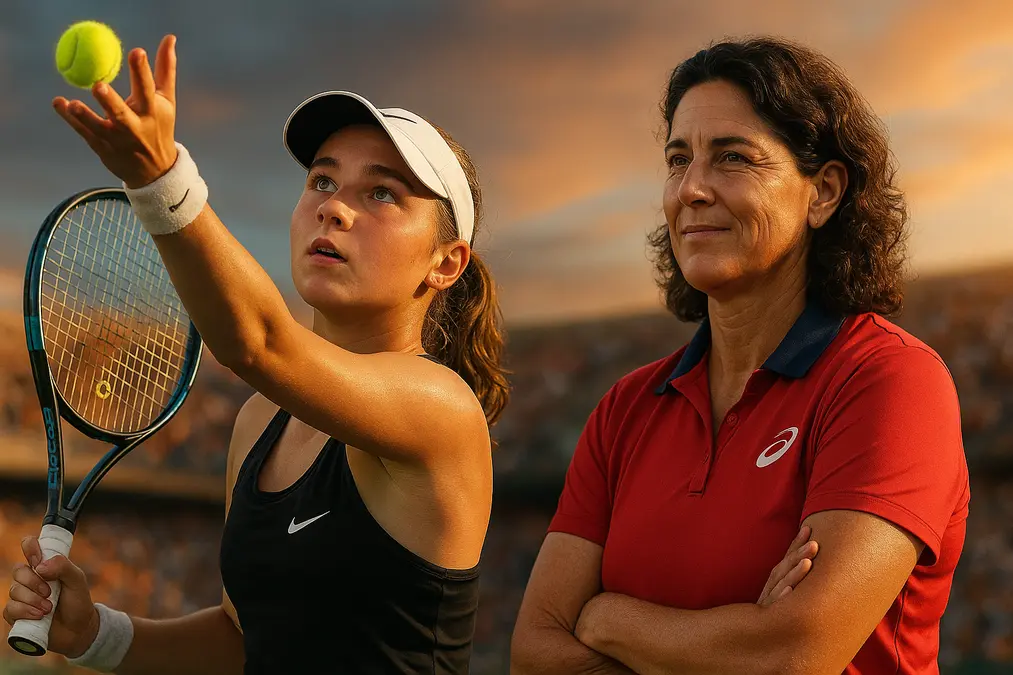

Mirra Andreeva’s rise has been nothing short of extraordinary. At just 18, the Russian teenager has already collected major titles, broken into the elite tier of the WTA, and proven she belongs among the game’s future stars. At the center of her ascent stands Conchita Martínez — a Grand Slam champion and one of the most respected minds in tennis.
Yet not everyone is convinced this partnership is flawless. Former World No. 3 Elena Dementieva has voiced concerns, questioning whether Martínez’s influence is truly unlocking Andreeva’s full potential — or quietly placing limits on it.
A Partnership That Delivered Instant Results
Andreeva and Martínez officially began working together on April 8, 2024, following a successful trial period ahead of the clay season. The impact was immediate. Just weeks later, Andreeva reached her first Grand Slam semifinal at Roland Garros, a breakthrough that confirmed the chemistry between player and coach.
The momentum carried on. Over the past year, Andreeva enjoyed the most productive stretch of her young career, highlighted by back-to-back WTA 1000 titles at the Dubai Duty Free Tennis Championships and Indian Wells — a rare feat that firmly established her among the tour’s elite.
Although she finished the 2025 season with a slight dip in form, the reset was brief. Andreeva opened 2026 with a title at the Adelaide International, defeating fellow rising star Victoria Mboko in the final. As the season intensifies and major ranking points come into play, expectations around her remain sky-high.
Dementieva Questions Martínez’s Influence
Despite the success, Elena Dementieva is not fully sold on the long-term direction of Andreeva’s game. Speaking to First&Red via Championat, the former Grand Slam finalist suggested Martínez’s playing philosophy may be shaping Andreeva in ways that don’t fully suit her strengths.
“You can clearly see Conchita Martínez’s influence,” Dementieva said. “I played against her on tour — and even when I won, those matches were pure torture.”
She described Martínez’s style as built around constant rhythm disruption, variation, and subtle changes of pace — effective, but draining.
“Slice on the backhand, that looping half-volley on the forehand — over and over. It was incredibly difficult. You never felt comfortable out there.”
“Why Does Mirra Need This?”
While Dementieva acknowledged that this approach made sense for Martínez herself, she questioned its relevance for Andreeva.
“For Conchita, it worked. She was a Wimbledon champion — but she was never a super-athlete. She wasn’t explosive. She played at a tempo that suited her. But Mirra? Why does she need that?”
The implication is clear: Andreeva possesses greater athleticism and firepower than her coach ever did — tools that, in Dementieva’s view, are not being fully maximized.
A Call for More Aggression
Dementieva believes Andreeva’s next step must involve a more assertive mindset on court.
“I want her to speed things up. To be more active. To counter, to attack. That’s the kind of tennis that will bring her wins in the future.”
She also pushed back against criticism following Andreeva’s Australian Open fourth-round exit, insisting the performance was far from disastrous.
“I didn’t see a catastrophe. Saying she can’t win a Grand Slam with this game is simply wrong.”
Still, her broader message remains firm: variety has value, but initiative matters most at the highest level.
“Look at the top players — they play very active, very powerful tennis.”
Whether Andreeva continues evolving within Martínez’s framework or gradually reshapes her identity will be one of the most fascinating storylines of the coming seasons.
Whichever way you look at it, both seem at ease — and Mirra Andreeva’s happiness is the only thing that truly matters.