
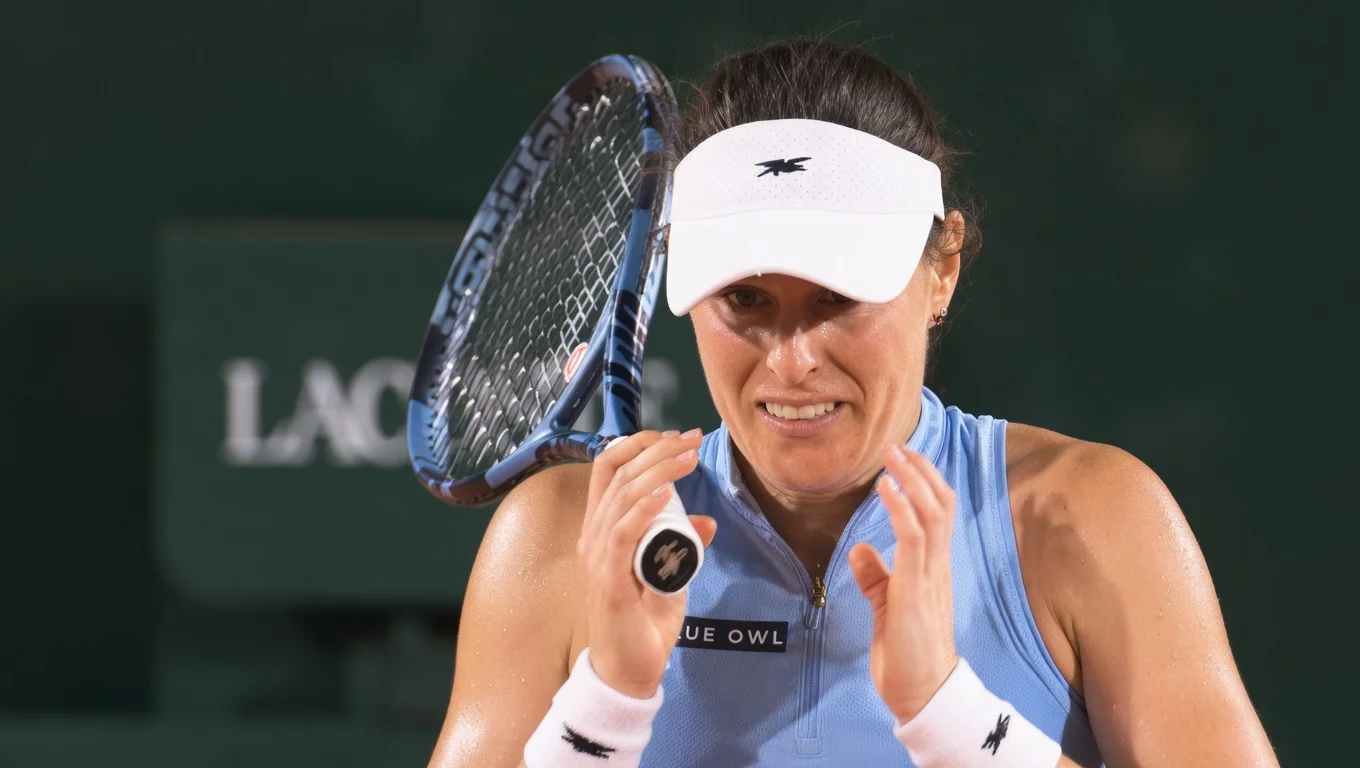
For one set, Kimberly Birrell looked trapped in the wrong Netflix documentary about an Australian comeback.
Not quite Kylie Minogue stating her singing was a five, perhaps, but something painfully close: a player standing on the red clay of Roland Garros, looking across at Jessica Pegula, and wondering whether the level was simply too far away.
Pegula took the first set 6-1. It was spectacular at times, clean and predictable. The American looked like the fifth seed, the established major performer, the player who had been to the deep end of Grand Slam draws often enough to know how to avoid first-round trouble.
Then Birrell started to grow into the evening.
Point by point, game by game, Birrell’s match began to resemble the shape of a comeback documentary: the early doubt, the awkward silence, the slow return of timing, and then the moment when the room starts to realise the performer is still there.
She found volume. She found rhythm. She found enough belief to stop playing like a guest in Pegula’s match. By the end, after a 1-6, 6-3, 6-2 comeback that knocked the first top-10 player out of the women’s draw, Birrell could look Paris in the eye and tell Australia back home exactly how good she had played.
It was not the Pyramid Stage, but it was close enough in spirit.
For Birrell, this was her own little Glastonbury: the afternoon when doubt gave way to applause, and an Australian who had been easy to overlook suddenly made everyone listen.
But How? Birrell Had No Paris History, Pegula Had Plenty
That is what makes this result so startling.
Birrell did not arrive with a Grand Slam record that whispered danger. Before Roland Garros 2026, she had gone 3-13 in the main draws of majors and 0-2 at the French Open. She had never won a main-draw match in Paris. Her résumé said survival, effort, near-misses and long roads.
Pegula’s said something else entirely.
The American came in with a 62-29 Grand Slam record and an 11-7 mark at Roland Garros. She had reached the French Open quarter-finals in 2022, made the fourth round again in 2025, and built the kind of major consistency that separates top-five players from the rest of the tour.
So when Pegula opened 6-1, the match seemed to be drifting into familiar territory.
And it was not just the score. It was the way the American was hitting the ball. This was not the slow starter she sometimes reproaches herself for being.
This was razor-sharp tennis, the kind that made Birrell look like a junior for long stretches of the opening set. Pegula looked like the player deciding how long the match would last.
And yet, unbelievably, that idea did not survive the second set.
Birrell vs Pegula – Set One Stats
| Statistic | Birrell | Pegula |
|---|---|---|
| Dominance Ratio | 0.41 | 2.46 |
| Winners | 3 | 11 |
| Unforced Errors | 10 | 6 |
| Serve Rating | 91 | 266 |
| Aces | 0 | 3 |
| Double Faults | 0 | 1 |
| 1st Serve % | 71% (10/14) | 57% (13/23) |
| 1st Serve Points Won | 20% (2/10) | 77% (10/13) |
| 2nd Serve Points Won | 0% (0/5) | 55% (6/11) |
| Break Points Saved | 0% (0/3) | 50% (1/2) |
| Service Games | 0% (0/3) | 75% (3/4) |
| Ace % | 0% | 13% |
| Double Fault % | 0% | 4.3% |
| Return Rating | 143 | 380 |
| 1st Return Points Won | 23% (3/13) | 80% (8/10) |
| 2nd Return Points Won | 45% (5/11) | 100% (5/5) |
| Break Points Won | 50% (1/2) | 100% (3/3) |
| Return Games | 25% (1/4) | 100% (3/3) |
| Pressure Points | 33% (2/6) | 67% (4/6) |
| Service Points | 14% (2/14) | 65% (15/23) |
| Return Points | 35% (8/23) | 86% (12/14) |
| Net Points | 33% (1/3) | 33% (1/3) |
| Total Points | 27% (10/37) | 73% (27/37) |
| Set 1 Duration | 0h24m | |
Pegula Starts Like a Top-Five Player, Then the Match Turns
Tennis is cruel like that. One set can look like proof. The next can expose it as temporary luxury.
Birrell changed the tone in the second. She became more aggressive on return, especially against Pegula’s second serve, and started stretching baseline rallie. She began to disturb the American’s patterns with looped forehands to the corners. Pegula’s service games became less comfortable. The clean authority of the opener began to loosen. Birrell began to gain confidence. Literally shot by shot.
At 5-3 in the second set, Birrell was no longer hoping the match might turn. She was making it turn.
The Australian leveled the match at 6-3, and suddenly the upset was no longer theoretical. The look in her eyes did not reveal it. She could not believe what had happened.
Birrell vs Pegula – Set Two Stats
| Statistic | Birrell | Pegula |
|---|---|---|
| Dominance Ratio | 1.14 | 0.88 |
| Winners | 11 | 8 |
| Unforced Errors | 9 | 13 |
| Serve Rating | 276 | 231 |
| Aces | 1 | 3 |
| Double Faults | 0 | 0 |
| 1st Serve % | 81% (25/31) | 68% (17/25) |
| 1st Serve Points Won | 64% (16/25) | 65% (11/17) |
| 2nd Serve Points Won | 50% (4/8) | 45% (5/11) |
| Break Points Saved | 75% (3/4) | 60% (3/5) |
| Service Games | 80% (4/5) | 50% (2/4) |
| Ace % | 3.2% | 12% |
| Double Fault % | 0% | 0% |
| Return Rating | 180 | 131 |
| 1st Return Points Won | 35% (6/17) | 36% (9/25) |
| 2nd Return Points Won | 55% (6/11) | 50% (4/8) |
| Break Points Won | 40% (2/5) | 25% (1/4) |
| Return Games | 50% (2/4) | 20% (1/5) |
| Pressure Points | 69% (9/13) | 31% (4/13) |
| Service Points | 61% (19/31) | 56% (14/25) |
| Return Points | 44% (11/25) | 39% (12/31) |
| Net Points | 83% (5/6) | 50% (1/2) |
| Total Points | 54% (30/56) | 46% (26/56) |
| Set 2 Duration | 0h39m | |
Birrell Goes From Hanging On to Hunting Pegula Down
The final set was where the deeper shock arrived.
Pegula still had time to steady herself. She had the ranking, the experience and the Grand Slam mileage. She had seen enough awkward matches to know that the first priority in a deciding set is to stop the opponent’s belief from becoming too loud.
But Birrell would not go quiet.
She had already changed the match before the third set truly settled. The question was whether she could keep the door open once Pegula tried to push back.
The decider started with Pegula edging ahead, but Birrell answered quickly. She broke for 2-1, survived a bruising hold for 3-1, and then kept enough distance when Pegula steadied for 3-2.
This was not a wild swing-and-hope comeback. Birrell was making Pegula play awkward points, extending rallies and forcing the fifth seed to find answers that were no longer coming easily.
She held for 4-2, broke again for 5-2, and suddenly stood one game from the biggest win of her career. Then came the final wobble: serving for the match, Birrell was broken back.
But the moment did not escape her. At 5-3, with Pegula serving to stay in the tournament, Birrell broke again to finish it.
She closed the third set 6-3 at her second match point.
Pegula was gone.
Birrell vs Pegula – Set Three Stats
| Statistic | Birrell | Pegula |
|---|---|---|
| Dominance Ratio | 1.34 | 0.75 |
| Winners | 10 | 11 |
| Unforced Errors | 9 | 19 |
| Serve Rating | 259 | 182 |
| Aces | 0 | 1 |
| Double Faults | 0 | 1 |
| 1st Serve % | 71% (24/34) | 72% (21/29) |
| 1st Serve Points Won | 67% (16/24) | 52% (11/21) |
| 2nd Serve Points Won | 46% (6/13) | 18% (2/11) |
| Break Points Saved | 80% (4/5) | 40% (2/5) |
| Service Games | 75% (3/4) | 40% (2/5) |
| Ace % | 0% | 3.4% |
| Double Fault % | 0% | 3.4% |
| Return Rating | 250 | 132 |
| 1st Return Points Won | 48% (10/21) | 33% (8/24) |
| 2nd Return Points Won | 82% (9/11) | 54% (7/13) |
| Break Points Won | 60% (3/5) | 20% (1/5) |
| Return Games | 60% (3/5) | 25% (1/4) |
| Pressure Points | 65% (11/17) | 35% (6/17) |
| Service Points | 59% (20/34) | 45% (13/29) |
| Return Points | 55% (16/29) | 41% (14/34) |
| Net Points | 83% (5/6) | 75% (3/4) |
| Total Points | 57% (36/63) | 43% (27/63) |
| Set 3 Duration | 0h44m | |
The Numbers Show Why This Was Strange, and Why Birrell Earned It
The full-match numbers are fascinating because they do not show a simple domination.
Pegula actually won more total points, 80 to 76, and had the higher dominance ratio, 1.06 to Birrell’s 0.94. She hit more winners, 30 to 24, and struck seven aces to Birrell’s one.
And still she lost.
That is where the match becomes more interesting than the usual upset script. Birrell won the points that changed the direction of the match. She took 13 of 24 pressure points, converted six of 12 break points, and broke Pegula six times. She also won 61 percent of Pegula’s second-serve return points, which became one of the biggest tactical cracks in the match.
Pegula’s 38 unforced errors hurt badly. Her forehand alone produced 22 unforced errors, and although she still won 51 percent of the total points, she could not win the match’s emotional centre once Birrell had taken it away from her.
Birrell’s net numbers also mattered. She won 11 of 15 points at the net, a 73 percent success rate, giving her a way to finish points when the baseline exchanges started to tilt.
The First Top-Seeded Exit of the Women’s Draw
Pegula’s defeat removes the fifth seed from Roland Garros in the opening round and gives the women’s tournament its first top-10 casualty.
That is not a small tremor. Pegula is one of the tour’s great stabilisers, a player who usually makes the draw behave more logically. Her losing this early opens space in the Sabalenka and Pegula quarter and gives the section a different mood immediately.
For Birrell, it is career-altering. Not because one win solves everything, but because some wins change how a player is seen — by opponents, by the tour, and sometimes by herself.
Before this match, her Roland Garros record said she had never found her footing here.
Now it says she knocked out Jessica Pegula.
That is quite a rewrite.
Birrell Gets Her Kylie Moment in Paris
Every Grand Slam has these moments.
A player who has spent years around the edges suddenly finds the spotlight. A favourite looks untouchable, then oddly human. A match that seems to be travelling in a straight line takes a sharp turn and ends up somewhere nobody had mapped.
Birrell’s win had all of that.
This was Birrell’s Kylie moment: not quite the Glastonbury Pyramid Stage, but close enough in spirit.
A reminder that reinvention does not always arrive with fireworks at the start. Sometimes it begins with doubt, a few hard looks across the net, and then the quiet realisation that the room is starting to listen.
Pegula had the ranking, the record and the experience.
Birrell found the stage, hit the chorus and made Paris hear her song. And in that Paris heat, somewhere further, you could almost imagine Kylie leaving the window open listening to it.