
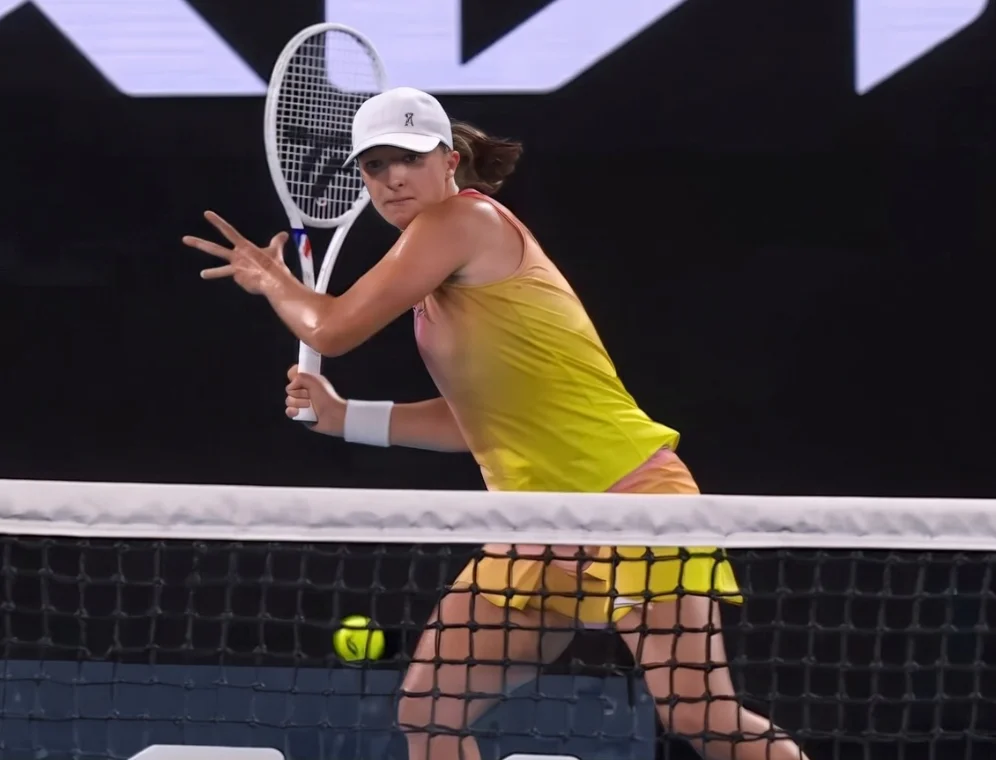

A coaching change at this level is rarely just about technique. With Iga Swiatek, Andy Roddick believes it runs far deeper.
The former US Open champion has offered a pointed reading of Swiatek’s split with Wim Fissette, suggesting the move reflects an internal struggle rather than a tactical reset. Speaking on his Served podcast, Roddick framed the decision as a response to mounting mental pressure — one that has subtly shaped her performances in recent months.
A reset timed for clay — but rooted elsewhere
Swiatek enters the clay season with Francisco Roig in her corner, a coach long associated with Rafael Nadal’s team and, by extension, with the rhythms of the surface that defined her own rise.
On paper, the move makes sense. Clay remains her strongest domain, and after a steady but unspectacular start to 2026 — marked by quarter-finals at the Australian Open and Indian Wells, but no titles — the timing aligns with a natural reset point in the calendar.
Yet Roddick sees the shift differently.
For him, the underlying cause is not what happens between points, but what happens between thoughts.
“She doesn’t let losses roll off”
Roddick’s central argument focuses on how Swiatek processes competition — not the results themselves, but the weight she assigns to them.
“She doesn’t let losses roll off and just go, ‘Okay, I’ll get the next one,’” he said. “She grabs onto them and holds on.”
It is a trait he recognises, even from his own career. But in Swiatek’s case, it creates a tension: success does not necessarily bring ease, and even victories can carry a trace of doubt.
“You’d think, ‘You just won Wimbledon,’ and she’s saying, ‘Yeah, but it was tough.’”
That mindset, Roddick suggests, has been visible for some time — even during periods that outwardly looked like success.
Success without flow
The Wimbledon title, achieved during her partnership with Fissette, did not fully mask that underlying friction.
Roddick pointed to earlier interviews where Swiatek spoke candidly about the difficulty of that period, hinting at a relationship that required effort rather than unfolding naturally.
“It didn’t seem like everything was clicking into place,” he noted. “It felt like something that needed work.”
That distinction matters. At the highest level, where margins are minimal, the difference between functional and instinctive can define entire seasons.
Swiatek’s 2026 results reflect that nuance. She remains firmly among the elite, but the sense of control that once set her apart has appeared less consistent.
Coaching as chemistry, not just correction
Roddick broadened the discussion beyond Swiatek, framing coaching in tennis as one of the most personal dynamics in sport.
“It’s the most personal coach-player relationship there is,” he said. “You’re constantly together. After your 220th dinner, things can change.”
In that context, even a successful partnership can reach its natural limit.
“Fissette is a great coach. He’s had success with so many players. But it’s not just about X’s and O’s — it’s about personalities, about whether things flow.”
The analogy he offered was simple, if telling: sometimes, it comes down to not liking the same music.
Expectations shifting faster than results
The broader backdrop is one of shifting expectations.
Swiatek’s season, by most standards, remains strong. But at her level, the benchmark is not participation — it is dominance.
“It’s amazing how quickly expectations change,” Roddick said. “You can have a pretty good start to the year, and suddenly you’re being judged against what you were six months ago.”
That gap — between current performance and past peak — is where pressure settles.
Clay as both refuge and test
The move to clay now offers both familiarity and scrutiny.
Historically, this has been the phase where Swiatek reasserts control. Four Roland Garros titles have established her authority on the surface, and Roig’s arrival signals an attempt to reconnect with that identity.
But if Roddick’s reading holds, the key adjustment will not come from stroke mechanics or tactical tweaks.
“It feels much more mental than coaching-related,” he concluded.
Which leaves Swiatek in a familiar, if uncomfortable, position: searching not for a new game, but for the clarity that once made it feel inevitable.