
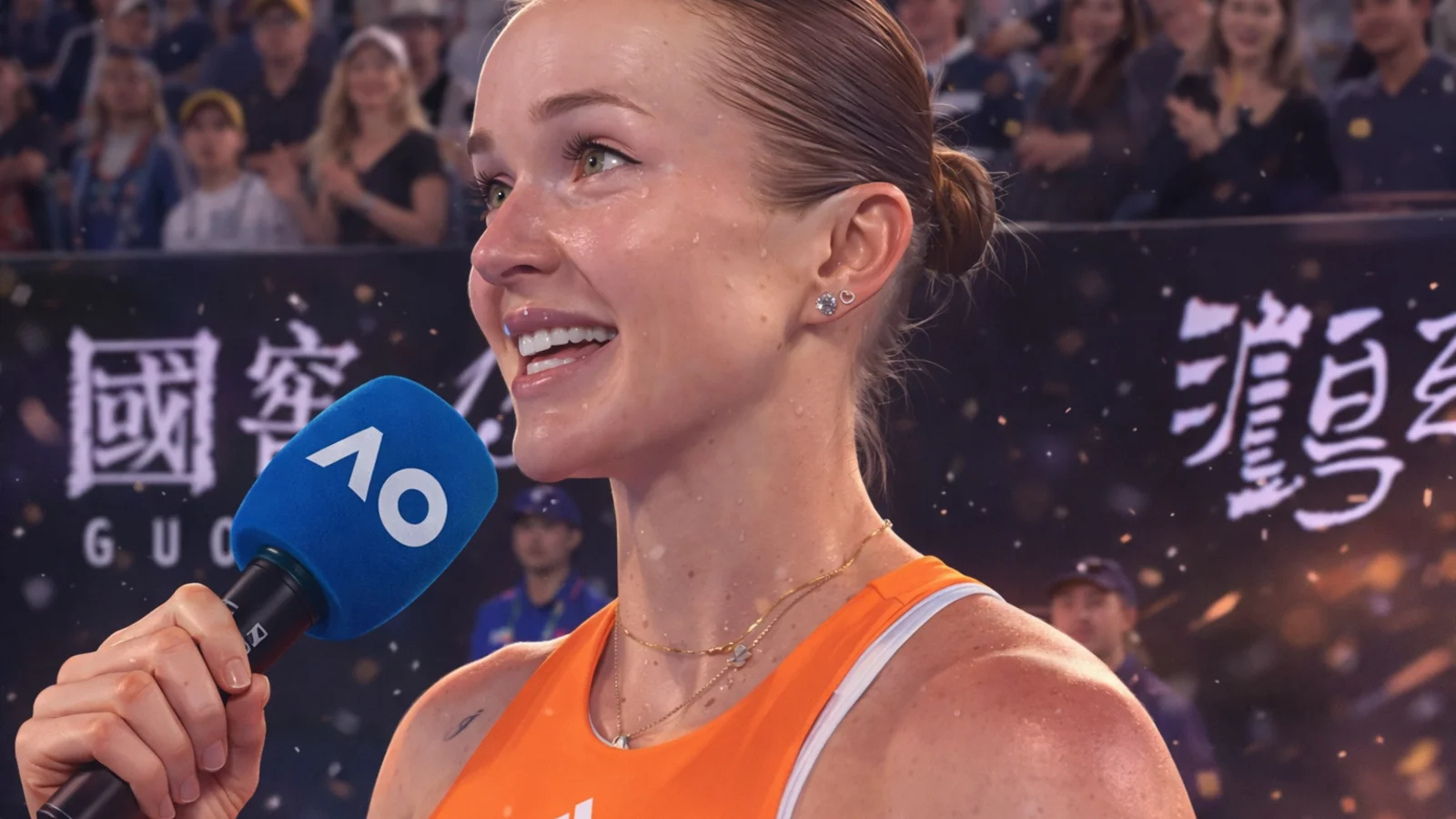

There are players who compete for ranking points. And then there are players who compete for something heavier.
Elina Svitolina has never hidden her stance on Russian and Belarusian players during the ongoing war in Ukraine. For her, the conflict is not an abstract headline. It is personal. And on the WTA Tour, that conviction has become part of her competitive identity.
No Handshake, No Silence
The images have become familiar. Svitolina walks to the net — and walks past.
Since Russia’s invasion of Ukraine, she has refused post-match handshakes with players representing Russia or Belarus. It is no longer shocking. It is understood.
She has also used the winner’s camera — usually reserved for playful signatures — to deliver messages with weight. After reaching the final of the Dubai Duty Free Tennis Championships, she wrote: “Fight like Ukraine.”
Speaking to Channel 24, Svitolina explained why she uses her platform.
“Sport has been pushed into the background for many years — that’s very sad,” she said. “But it seems the world does not fully understand. Athletes are the ones who, with their results and their voice, can remind the world about Ukraine.”
This is not symbolism for symbolism’s sake. It is deliberate visibility.
Motivation, Not Distraction
For Svitolina, the political dimension has sharpened rather than clouded her tennis.
“It’s motivation for me — to climb higher in the rankings and play better in order to beat them,” she said. “It’s a personal challenge. During the war, to play against them and to beat them is my mission on the court.”
Those words have translated into performance.
The 31-year-old opened the season with ten consecutive wins in Australia, capturing the ASB Classic title by defeating Xinyu Wang in the final. She then surged to the semifinals of the Australian Open, where world No.1 Aryna Sabalenka ended her run.
Along the way, she faced multiple Russian-born opponents. Varvara Gracheva — now representing France — came first. Then came a double test of Russian talent: Diana Shnaider and Mirra Andreeva, both dispatched in straight sets as Svitolina’s level remained uncompromising.
The Rod Laver Arena crowd briefly misunderstood the situation when Andreeva instinctively shook hands with the umpire rather than Svitolina. Boos followed, confusion lingered, but the principle remained unchanged.
Svitolina did not pose for photos with Sabalenka before their semifinal. After her first loss of 2026, she gestured toward the now-familiar signage indicating there would be no handshake.
The line is clear. And it does not move.
Results Backing the Conviction
Her only other early setback this season came in Doha, where Anna Kalinskaya produced a surprise in the Round of 16 at the Qatar Open.
Svitolina responded the way contenders do.
In Dubai, she defeated Belinda Bencic and Coco Gauff en route to the WTA 1000 final. There, a red-hot Jessica Pegula proved too strong. But the message was unmistakable: Svitolina is playing at a level that places her firmly back in the conversation for the sport’s biggest prizes.
She is currently ranked inside the Top 10 once more. And the climb feels purposeful.
From a WTA perspective, this is a reminder of what elite sport often becomes in turbulent times. It is not only about forehands and footwork. It is about identity, conviction and the willingness to stand visibly alone.
Svitolina’s stance may divide opinion. Her tennis, increasingly, does not.
And in a season already marked by sharp intent and deep runs, she has made one thing clear: her voice travels as far as her newly aggressive style of tennis.