
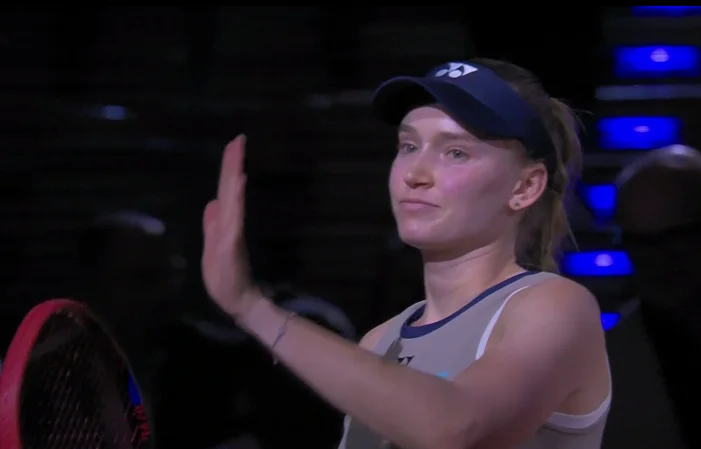
Elena Rybakina’s early-season authority has been difficult to ignore, even if she continues to downplay it. The Kazakh sits atop the 2026 WTA Race, her titles in Melbourne and Stuttgart forming the backbone of a campaign built as much on control as on headline moments. Yet as Madrid begins, her emphasis remains fixed elsewhere.
“I do not only think about the ranking,” she said. “I believe the main focus is on the Grand Slams, on winning those kinds of titles.”
It is a perspective that sits neatly alongside her season: efficient, grounded, and notably resistant to distraction.
Results strong, but refinement ongoing
Her Stuttgart run, capped by a 7-5, 6-1 win over Karolína Muchová, was emblematic. It was not her most dazzling performance, but it did not need to be. Rybakina has moved through much of this year without reaching for her highest level, compiling a 25–5 record that speaks more to repeatability than peaks.
That consistency, across surfaces and conditions, has become her defining trait. Still, she is not presenting it as an endpoint.
“I would say it is different between 2022 and now,” she explained. “But I still do not think I am at my best level. I hope to continue improving, and that my best version comes soon, but it is not there yet.”
After all, Leylah Fernandez came very close to beating her in Stuttgart.
Madrid presents a different test
Madrid, however, introduces a different set of variables. The shift from Stuttgart’s indoor clay to the altitude of the Spanish capital alters timing and margins, often disrupting rhythm more than rankings might suggest.
Rybakina has approached the adjustment without overcomplication.
“The training session was good. Here, it is considerably faster, and also not indoors, so you need some time to adapt,” she said. “It was only my second day, and I believe I am gradually getting better.”
The conditions demand precision, particularly in the opening exchanges.
“The ball flies a lot here, so I have to be careful with the initial shots,” she added. “You have to be prepared for all of that, but at the same time, it’s the same for the opponent.”
Controlled aggression remains her base
There is no sense of reinvention—only calibration. Her game, built on first-strike aggression, remains intact, though its application has become more measured.
“I think I will try to adapt, depending on the opponent, and see what works here and what does not,” she said. “But overall, it will be the same: trying to be aggressive.”
That balance between identity and adjustment has underpinned her results. She is not expanding her game for its own sake, but she is no longer confined by rigid patterns.
Sabalenka rivalry sharpens the picture
Inevitably, her position at the top of the Race sharpens the focus on Aryna Sabalenka. Their rivalry has developed into a study in fine margins—two aggressive baseliners pushing each other to sustain precision under pressure.
“We push each other to improve,” Rybakina said. “We are both very aggressive, do not expect errors from the other; you have to take the initiative.”
Matches between them have become less about contrast and more about execution—who strikes cleaner, who holds nerve.
“Beyond the result, it is always positive to play against these kinds of players,” she added. “You grow, learn.”
Perspective intact despite momentum
For all the momentum she carries into Madrid, Rybakina’s outlook remains strikingly even. Rankings and results sit in the background, acknowledged but not indulged.
“Each season is a process, and if it happens, great,” she said.
It is a sentiment that mirrors her tennis—uncluttered, controlled, and quietly ambitious. She arrives as the form player of 2026. She speaks as if the real work is still ahead.