
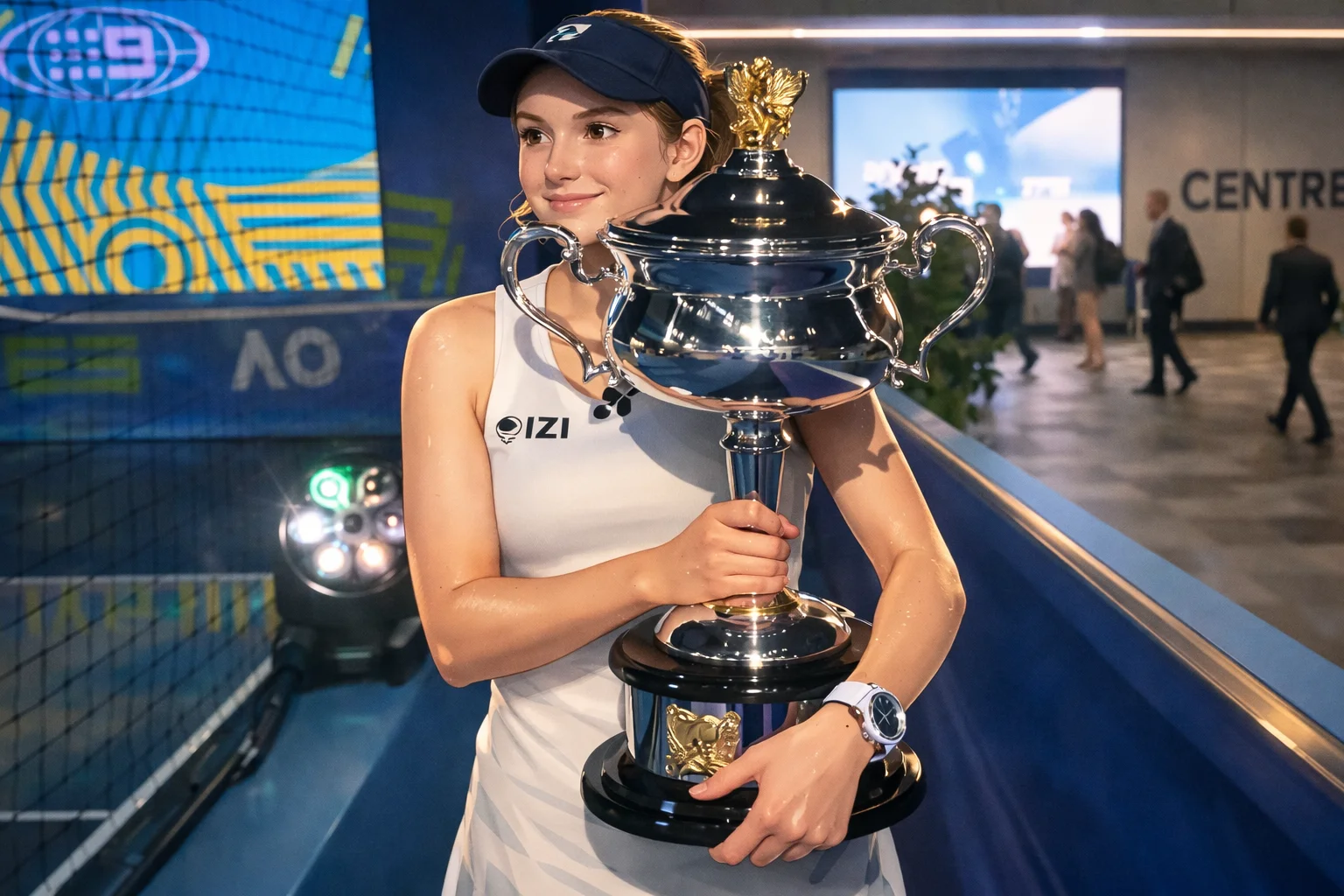

Elena Rybakina’s season feels suspended between two climates.
On one side, the heat of Doha and Dubai, where she now lives and trains, pushing through long rallies under desert skies. On the other, the icy spectacle of the Winter Olympics, where athletes launch themselves into the unknown with fearless precision. Rybakina has been watching both worlds unfold — one as a spectator, the other as a central protagonist.
And right now, her own trajectory may be just as daring as any downhill run. We will explain the path in this article.
Rybakina: From Melbourne Glory to a New Ceiling
Winning the Australian Open changed the temperature around Rybakina’s career.
Her second Grand Slam title did more than confirm what many already believed — that she is one of the cleanest ball-strikers in the sport. It brought her back to World No. 3, matching her career high, and positioned her as a legitimate contender not just for more majors, but for the very top ranking in tennis.
The ambition is no longer subtle.
“It is definitely a goal,” Rybakina said on the Al Ersal Podcast when asked about reaching World No. 1. “But it depends on how others play and what results they get. The season is very long. There’s no time to stop. You need to improve every day.”
There is no bravado in her tone — only calculation.
In the WTA Race, Rybakina currently leads with 2,330 points, more than 500 ahead of Aryna Sabalenka. But the official rankings tell a more complex story: Sabalenka still holds a commanding advantage, sitting roughly 3,000 points ahead of Iga Swiatek and more than 3,400 ahead of Rybakina.
The summit is visible — but still steep.
Doha: A Warning Sign and a Reminder
Her campaign in Doha offered both reassurance and caution.
Rybakina extended her winning streak to nine matches before falling in the quarter-finals to Victoria Mboko — the Canadian teenager who continues to reshape the tour’s hierarchy. Rybakina fired 11 aces and won 83% of her first-serve points. Against most opponents, that is enough.
Against Mboko, it wasn’t.
It marked the second time their rivalry tilted unpredictably. Rybakina had taken their first meeting in Washington. Mboko responded with a statement victory en route to her Canadian Open title in Montreal. Rybakina then edged her again in Tokyo to secure her WTA Finals berth. Doha became another chapter — one that confirmed this is no fluke matchup.
The Kazakh did not collapse. She was outplayed at the margins.
And in a season defined by margins, that matters.
Winter Dreams and Competitive Instinct
While Doha unfolded, the Winter Olympics captivated global audiences. Rybakina, like many players, has been following the spectacle.
Asked which winter sport she would try, she smiled: “Maybe skiing because I never actually did it. I know how to ski on the flat, but not the other way. So that would be interesting to try.”
Ice skating? Not likely.
“I did ice skating when I was young, but I’m too tall for this sport, for sure.”
The contrast is poetic: winter athletes carving through ice while Rybakina carves through hard courts. Precision, balance, control under pressure — the parallels are obvious.
Across the tennis world, others are equally captivated. Novak Djokovic has spoken about watching figure skating in awe. Jannik Sinner, once an elite junior skier, serves as an ambassador for the Games. Jasmine Paolini carried the Olympic torch to Milan.
Sport feeds sport.
And Rybakina, quietly, feeds on competition.
The Five-Set Debate: A Revealing Answer
As Tennis Australia considers introducing five-set matches for women from the quarter-finals onward in future editions, Rybakina’s reaction was telling.
“I would like to stay with three sets,” she said. “Five is quite a lot. I’m not sure the quality of the matches would be the same.”
It wasn’t resistance. It was realism.
Her game is built on explosive efficiency — high-percentage serving, first-strike aggression, controlled tempo. Extending matches alters rhythm and physical economics. Rybakina understands that titles are not won on ideology, but on margins of energy.
In today’s dense calendar, she has already spoken about the toll of overplaying.
“We have so many tournaments… you just need to keep going. The goal is definitely to go higher in the ranking and win another Slam.”
There is no romanticism. Only clarity.
Dubai: Home, Pressure, and Possibility
Now the focus shifts to Dubai — a tournament that is more than just another WTA 1000 stop.
This is home territory for Rybakina. Familiar courts. Familiar climate. Familiar expectations.
She enters as top seed, with Sabalenka and Swiatek absent after late withdrawals. The pathway is open — but not forgiving. A deep run could narrow the ranking gap and reinforce her Race lead. A stumble could shift the momentum narrative.
Potential opponents loom: Emma Raducanu, Belinda Bencic, Paula Badosa, Elina Svitolina. The draw offers no free passage.
But it also offers opportunity. On paper this looks easier than Doha.
The Long Climb to No.1
History suggests patience.
The last ten players to become World No.1 — from Caroline Wozniacki to Aryna Sabalenka — all required sustained excellence, not bursts. Many hovered inside the Top 3 for months before finally ascending.
Rybakina is now in that corridor.
She has the serve.
She has the temperament.
She has the major titles.
What she needs now is accumulation.
Accumulation Explained
As said, over the past decade, the road to World No. 1 in women’s tennis has followed a clear pattern. It is no longer enough to have one magical season or a brief surge of brilliance. The modern summit demands weight — Grand Slam weight — and sustained dominance.
If we look at the last ten women to reach World No. 1 for the first time, the trend is striking.
| Player | Country | First No.1 | Weeks at No.1 | Grand Slam Titles |
|---|---|---|---|---|
| Iga Swiatek | POL | 2022-04 | 125 | 6 |
| Naomi Osaka | JPN | 2019-01 | 25 | 4 |
| Aryna Sabalenka | BLR | 2023-09 | 77 (in progress) | 4 |
| Ashleigh Barty | AUS | 2019-06 | 121 | 3 |
| Angelique Kerber | GER | 2016-09 | 34 | 3 |
| Victoria Azarenka | BLR | 2012-01 | 51 | 2 |
| Simona Halep | ROU | 2017-10 | 64 | 2 |
| Garbine Muguruza | ESP | 2017-09 | 4 | 2 |
| Caroline Wozniacki | DEN | 2010-10 | 71 | 1 |
| Karolina Pliskova | CZE | 2017-07 | 8 | 0 |
Two things stand out immediately.
First, Grand Slams matter more than ever. Eight of the last ten first-time No. 1s owned multiple majors. Since 2019, every player who has climbed to the top has carried at least three Slam titles — except Osaka, whose four majors propelled her there rapidly. The Pliskova-era of the Slam-less No. 1 appears to be over.
Second, longevity correlates with Slam volume. Swiatek (6 Slams) and Barty (3) crossed the 100-week mark. Multi-Slam champions tend to stay.
This is where Elena Rybakina enters the conversation.
She already holds two Grand Slam titles — Wimbledon and the Australian Open — and currently leads the WTA Race. In the official rankings she sits at No. 3, but the distance to the top is no longer symbolic. It is mathematical.
Historically, two Slams place her firmly within the traditional No. 1 blueprint. Azarenka and Halep both reached the summit with two majors. Muguruza did as well. The difference today is that the standard has risen. Swiątek and Sabalenka have redefined the pace. The modern hierarchy demands accumulation.
What Rybakina needs now is not another explosion. It is consolidation.
Consistency Over Spectacle
Her fans understand this. They have sat with her through several seasons since that Wimbledon breakthrough. They have seen the brilliance — the first-strike dominance, the clean power, the calm under pressure.
But there were also slips. Weeks where momentum stalled. Opportunities that evaporated before becoming streaks.
The ranking table shows that brief peaks rarely last. Pliskova held the top spot for eight weeks. Muguruza for four. Without sustained title accumulation, the summit becomes temporary.
Rybakina’s profile suggests something more durable is possible. She is already a multi-Slam champion. She leads the Race. She competes well at WTA 1000 level. And crucially, she is still building.
The modern No. 1 formula is clear:
- Multiple Slams
- Deep WTA 1000 runs
- Year-round accumulation
- Fewer ranking “gaps” between big weeks
She does not need to transform her game. She needs to stack.
The summit is not mythical. It is measurable.
The last decade tells us that World No. 1 is no longer won in one season of magic. It is earned through layered excellence.
If she adds accumulation to her power, stability to her brilliance, and consistency to her Slam pedigree, history suggests only one direction remains: Up.
A Season on the Edge of Transformation
Rybakina’s 2026 campaign already feels transitional.
She is no longer chasing validation.
She is chasing legacy.
The loss to Mboko in Doha was not a derailment — it was a signal. The new generation is arriving faster than expected. The margin between dominance and vulnerability is shrinking.
But if anything, it sharpens her focus.
The Australian Open trophy sits in her cabinet. The Race standings favor her. The ranking summit is mathematically reachable.
And in Dubai, under familiar skies, she will try to begin her next ascent. In Doha, the surge stalled. In Dubai, it must take shape.