


Last updated: 16 February 2026.
Understanding how ranking points are awarded in women’s tennis is key for players, fans, and analysts alike. From the prestige of WTA Majors to the stepping stones of ITF W15 tournaments, this comprehensive breakdown covers everything you need to know. How often do we find ourselves wondering how many ranking points our favorite player has earned during a tournament? Bookmark this page for easy reference—it’s a must-have for anyone passionate about WTA tennis rankings!
The WTA singles ranking is a rolling 52-week system: points from each tournament stay on your total until that event drops off a year later.
A player’s ranking is calculated from their best 18 results in that period (with Grand Slams and key WTA events typically counting toward that total).
Table of contents
- How WTA Ranking Points Work
- Grand Slam Ranking Points Breakdown
- WTA 1000 Ranking Points Explained
- WTA 500 Ranking Points
- WTA 250 Ranking Points
- WTA 125 Series
- ITF Women’s Tour Ranking Points (W100 to W15)
- Example 1: Aryna Sabalenka at the US Open
- Example 2: Iga Swiatek at a WTA 500
- Frequently Asked Questions About WTA Rankings
How WTA Ranking Points Work
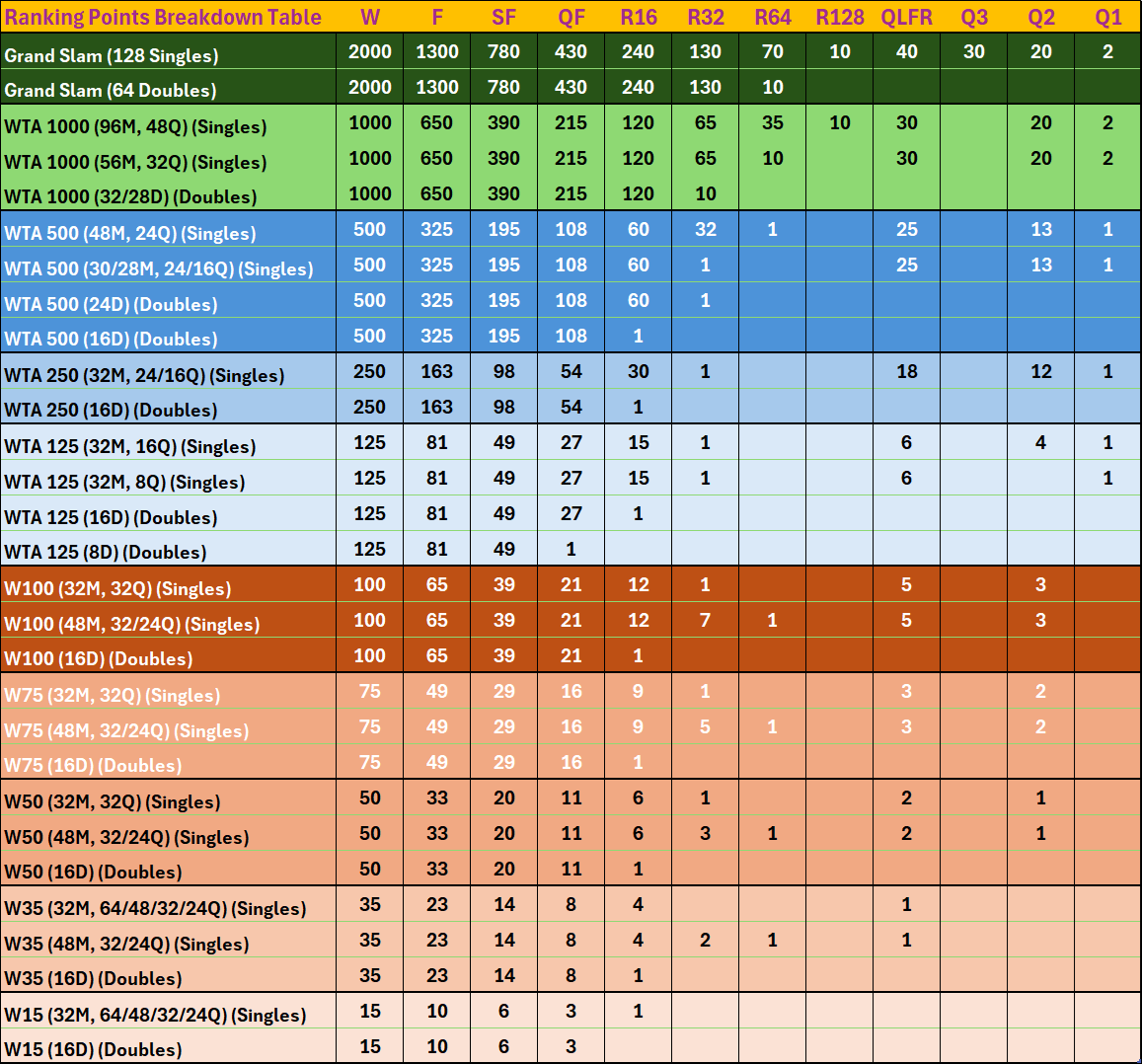
Note: The table above has been updated for WTA Calendar Season 2026
Grand Slam Ranking Points Breakdown
Grand Slams sit at the top of women’s tennis because they offer the biggest ranking-point rewards and can reshape a player’s season in one run. In a 128-player singles main draw, points rise sharply with every round you survive — and even the qualifying rounds pay out, rewarding players who fight their way into the main event.
Official websites: Australian Open, Roland Garros, Wimbledon, and US Open
Main draw 128 Singles
- Winner: 2,000 points
- Finalist: 1,300 points
- Semifinalist: 780 points
- Quarterfinalist: 430 points
- Round of 16: 240 points
- Round of 32: 130 points
- Round of 64: 70 points
- Round of 128: 10 points
- Qualifier: 40 points
- Qualifying Round 3: 30 points
- Qualifying Round 2: 20 points
- Qualifying Round 1: 2 points
WTA 1000 Ranking Points Explained
WTA 1000 tournaments are the highest-tier events on the regular tour calendar, sitting just below the Grand Slams in prestige and ranking-point value.
They come in different draw formats (for example, larger main draws with more rounds versus smaller draws, and some with byes), so the points distribution can vary slightly depending on the event structure — but the headline remains the same: these are the biggest opportunities to build a ranking outside the majors.
Main draw 96 – Qualifiers 48
- Winner: 1,000 points
- Finalist: 650 points
- Semifinalist: 390 points
- Quarterfinalist: 215 points
- Round of 16: 120 points
- Round of 32: 65 points
- Round of 64: 35 points
- Round of 128: 10 points
- Qualifier: 30 points
- Qualifying Round 2: 20 points
- Qualifying Round 1: 2 points
Main draw 56 – Qualifiers 32
- Winner: 1,000 points
- Finalist: 650 points
- Semifinalist: 390 points
- Quarterfinalist: 215 points
- Round of 16: 120 points
- Round of 32: 65 points
- Round of 64: 10 points
- Qualifier: 30 points
- Qualifying Round 2: 20 points
- Qualifying Round 1: 2 points
WTA 500 Ranking Points
WTA 500 tournaments are a key middle tier on the tour: not as massive as the 1000s, but still highly valuable for ranking momentum and week-to-week consistency.
They also come in different draw formats (including versions with byes, such as 30/28-player Round 1 main-draw setups), which can slightly affect how early-round points are awarded — but deep runs here remain a major boost over the course of the 52-week season.
Main draw 48 – Qualifiers 24
- Winner: 500 points
- Finalist: 325 points
- Semifinalist: 195 points
- Quarterfinalist: 108 points
- Round of 16: 60 points
- Round of 32: 32 points
- Round of 64: 1 point
- Qualifier: 25 points
- Qualifying Round 2: 13 points
- Qualifying Round 1: 1 point
Main draw 30/28 – Qualifiers 24/16
- Winner: 500 points
- Finalist: 325 points
- Semifinalist: 195 points
- Quarterfinalist: 108 points
- Round of 16: 60 points
- Round of 32: 1 point
- Qualifier: 25 points
- Qualifying Round 2: 13 points
- Qualifying Round 1: 1 point
WTA 250 Ranking Points
WTA 250 tournaments are often the tour’s best opportunity for players to build steady ranking points, especially outside the very top tier. The formats can vary (different main-draw and qualifying draw sizes), but the idea is consistent: each round you win adds meaningful points, and a strong week at a 250 can be a real stepping stone toward higher-level events.
Main draw 32 – Qualifiers 24/16
- Winner: 250 points
- Finalist: 163 points
- Semifinalist: 98 points
- Quarterfinalist: 54 points
- Round of 16: 30 points
- Round of 32: 1 points
- Qualifier: 18 points
- Qualifying Round 2: 12 points
- Qualifying Round 1: 1 point
WTA 125 Series
WTA 125 tournaments (often called WTA 125s) sit just below the WTA 250 level and act as a crucial bridge between the main tour and the ITF circuit. They’re a prime place to collect solid ranking points, regain form, or build momentum between bigger weeks—especially for players pushing to break into (or back into) the top tiers of the WTA rankings.
Main draw 32 – Qualifiers 16
- Winner: 125 points
- Finalist: 81 points
- Semifinalist: 49 points
- Quarterfinalist: 27 points
- Round of 16: 15 points
- Round of 32: 1 points
- Qualifier: 6 points
- Qualifying Round 2: 4 points
- Qualifying Round 1: 1 point
Main draw 32 – Qualifiers 8
- Winner: 125 points
- Finalist: 81 points
- Semifinalist: 49 points
- Quarterfinalist: 27 points
- Round of 16: 15 points
- Round of 32: 1 points
- Qualifier: 6 points
- Qualifying Round 2: no round 2
- Qualifying Round 1: 1 point
What “30/28M” and “24/16Q” mean on WTA point charts
When you look at the official WTA/ITF ranking point tables, you’ll sometimes see tournament formats written in a shorthand like “WTA 500 (30/28M, 24/16Q) (Singles)”. These brackets are simply describing draw sizes — and how many players actually compete in each stage.
Main draw in WTA 500: “30/28M”
- M stands for Main draw.
- 30/28M means the main draw is a 32-slot bracket, but because some players receive byes, only 30 or 28 players actually play in Round 1 (R32).
In practice, that usually breaks down like this:
- 30M → typically 2 byes
- 28M → typically 4 byes
Those byes are given to seeded players, and the exact number depends on the tournament’s draw format.
Qualifying in WTA 250 and WTA 500: “24/16Q”
- Q stands for Qualifying draw.
- 24/16Q means the qualifying competition can be run with either a 24-player or 16-player qualifying draw.
Most commonly, that leads to:
- 24Q = commonly produces 6 qualifiers (note: 8 qualifiers for WTA 1000 – 32Q, or even 10 for WTA1000 – 48Q)
- 16Q = commonly produces 4 qualifiers
Those qualifiers then feed into the main draw, completing the final tournament field.
ITF Women’s Tour Ranking Points (W100 to W15)
The ITF Women’s World Tennis Tour is the foundation of the professional pathway in women’s tennis, ranging from entry-level events up to high-point tournaments like W100.
These tournaments let players start earning WTA ranking points, build match volume, and climb through the tiers step by step—often moving from ITF success into WTA qualifying, main draws, and eventually the biggest tour events.
ITF W100: Main draw 48 – Qualifiers 32/24
- Winner: 100 points
- Finalist: 65 points
- Semifinalist: 39 points
- Quarterfinalist: 21 points
- Round of 16: 12 points
- Round of 32: 7 points
- Round of 64: 1 point
- Qualifier: 5 points
- Qualifying Round 1: 3 points
ITF W100: Main draw 32 – Qualifiers 32
- Winner: 100 points
- Finalist: 65 points
- Semifinalist: 39 points
- Quarterfinalist: 21 points
- Round of 16: 12 points
- Round of 32: 1 point
- Qualifier: 5 points
- Qualifying Round 1: 3 points
ITF W75: Main draw 48 – Qualifiers 32/24
- Winner: 75 points
- Finalist: 49 points
- Semifinalist: 29 points
- Quarterfinalist: 16 points
- Round of 16: 9 points
- Round of 32: 5 points
- Round of 64: 1 point
- Qualifier: 3 points
- Qualifying Round 1: 2 points
ITF W75: Main draw 32 – Qualifiers 32
- Winner: 75 points
- Finalist: 49 points
- Semifinalist: 29 points
- Quarterfinalist: 16 points
- Round of 16: 9 points
- Round of 32: 5 points
- Qualifier: 3 points
- Qualifying Round 1: 2 points
ITF W50: Main draw 48 – Qualifiers 32/24
- Winner: 50 points
- Finalist: 33 points
- Semifinalist: 20 points
- Quarterfinalist: 11 points
- Round of 16: 6 points
- Round of 32: 3 points
- Round of 64: 1 point
- Qualifier: 2 points
- Qualifying Round 1: 1 point
ITF W50: Main draw 32 – Qualifiers 32
- Winner: 50 points
- Finalist: 33 points
- Semifinalist: 20 points
- Quarterfinalist: 11 points
- Round of 16: 6 points
- Round of 32: 1 point
- Qualifier: 2 points
- Qualifying Round 1: 1 point
ITF W35: Main draw 48 – Qualifiers 32/24
- Winner: 35 points
- Finalist: 23 points
- Semifinalist: 14 points
- Quarterfinalist: 8 points
- Round of 16: 4 points
- Round of 32: 2 points
- Round of 64: 1 point
- Qualifier: 1 point
ITF W35: Main draw 32 – Qualifiers 64/48/32/24
- Winner: 35 points
- Finalist: 23 points
- Semifinalist: 14 points
- Quarterfinalist: 8 points
- Round of 16: 4 points
- Qualifier: 1 point
ITF W15: Main draw 32 – Qualifiers 64/48/32/24
- Winner: 15 points
- Finalist: 10 points
- Semifinalist: 6 points
- Quarterfinalist: 3 points
- Round of 16: 1 point
The Basics: Winning = More Points
Every tournament on the WTA Tour offers ranking points. The deeper you go — from the first round to the final and ultimately the champion — the more points you collect. Bigger tournaments, like the Grand Slams, award far more points than smaller events.
Understanding this “point ladder” is essential because it explains why some results hardly move the rankings, while others can propel a player into the Top 10 overnight.
Tournament Levels: Why Size Matters
Think of WTA events as different levels in a video game. The higher the level, the more treasure (ranking points) at stake:
- Grand Slams (Australian Open, Roland Garros, Wimbledon, US Open): 2000 points for the winner. Even a single match win gives you a solid boost.
- WTA 1000s: Winners earn 1000–650 points, depending on the size. A quarterfinal can already mean 200+ points.
- WTA 500s: Champions get 500 points; quarterfinalists usually around 100.
- WTA 250s: Winners collect 250 points; quarterfinalists about 60.
- WTA 125s and ITF events: These are the entry levels, worth between 15 and 125 points for the champion.
The lesson is simple: big tournaments equal big rewards.
The 18-Best Rule: How Rankings Are Calculated
This is where precision matters. A player’s singles ranking is calculated from their best 18 tournaments over the past 52 weeks. Results outside of those 18 do not count.
This means two things:
- You cannot endlessly pile on points — only your top 18 results remain in play.
- Every new tournament is compared to the weakest tournament currently in your “Top 18.” If it’s better, it replaces that weaker result; if not, it doesn’t count at all.
Defending Points: Why Rankings Go Up or Down
Fans often hear that a player must “defend points” at a certain tournament. Here’s what that really means:
- If you did very well at a tournament last year, those points are set to “drop off” after 52 weeks.
- When you play the same event (or another event at the same time of year) this season, your new result is compared to what you are losing.
For example: If you made the semifinals in Monterrey in 2024 (185 points) but only reach the quarterfinals in 2025 (108 points), the live rankings don’t simply “add 108.” Instead, they compare 108 to the 185 you are losing. That leaves you with a net loss of 77 points.
And this isn’t limited to Monterrey. The same logic applies to any tournament. A player is always defending whichever tournament result is due to expire, and their new performance either matches, improves, or weakens that slot in their Top 18.
Why This System Matters
The 18-best structure explains why players sometimes win a match yet still drop in the live rankings. It’s not about whether they gained points in absolute terms, but whether their new performance was stronger or weaker than the one it replaced.
That’s why you’ll see live-ranking sites show gains or losses immediately — they calculate your updated total in real time, based on the rolling 52-week window.
Example 1: Aryna Sabalenka at the US Open
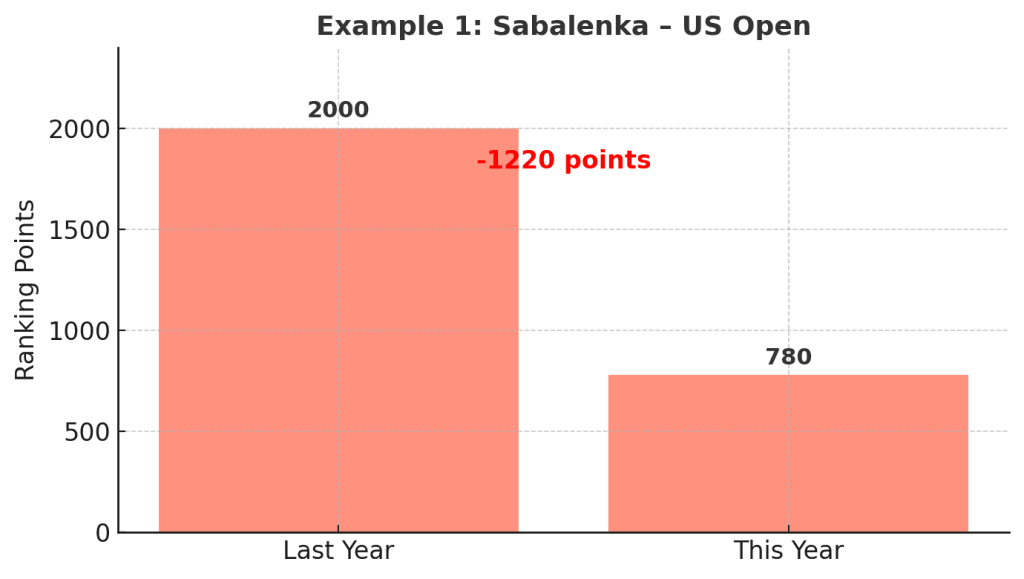
In 2024, Aryna Sabalenka won the US Open, which gave her 2000 ranking points. If in 2025 she would only have reached the semifinals, that is worth 780 points.
- Points earned in 2024: 2000
- Points earned in 2025: 780 (if she would’ve won it again: zero points change)
- Net change: 780 replaces 2000 → –1220 points
So even though a semifinal is a deep run, compared to last year’s title defense it represents a huge drop. That explains why fans sometimes see “negative” totals even after a strong performance.
Example 2: Iga Swiatek at a WTA 500
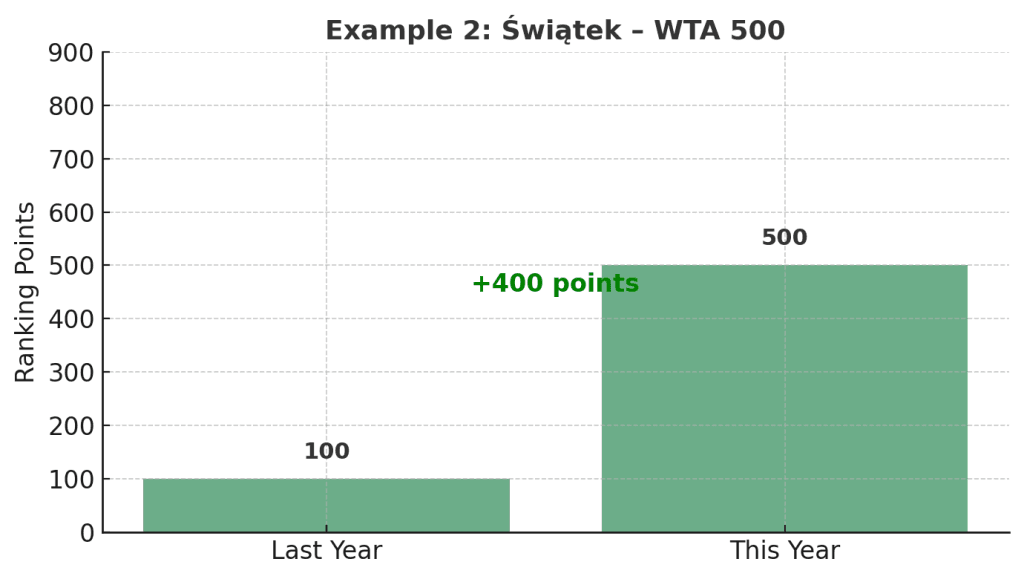
Imagine Iga Swiatek played a WTA 500 tournament in 2025 and lost in the quarterfinals, which gave her 100 points. In 2026, at the same time of year but at a different WTA 500, she wins the title and collects 500 points.
- Points defended: 100
- Points earned: 500
- Net change: 500 replaces 100 → +400 points
Here, the win doesn’t just add 500 — it replaces the 100 points in her 18-best count, leading to a clear ranking rise beacuse of the 400 points extra.
Final Takeaway
The WTA rankings are not simply an “adding game.” They are a year-long cycle of defending, replacing, and upgrading results across 18 tournaments. Understanding this explains why some players rocket up the ladder while others, even after decent weeks, can slip down.
Frequently Asked Questions About WTA Rankings
What are the ranking points for winning a Grand Slam in women’s tennis?
The winner of a Grand Slam earns 2000 WTA ranking points.
How many points does a WTA 1000 winner receive?
A WTA 1000 champion earns 1000 ranking points.
What is the difference between WTA and ITF ranking points?
WTA events offer significantly more points than ITF tournaments, which serve as entry-level professional competitions.
How long do WTA ranking points last?
Ranking points remain on a player’s record for 52 weeks.