
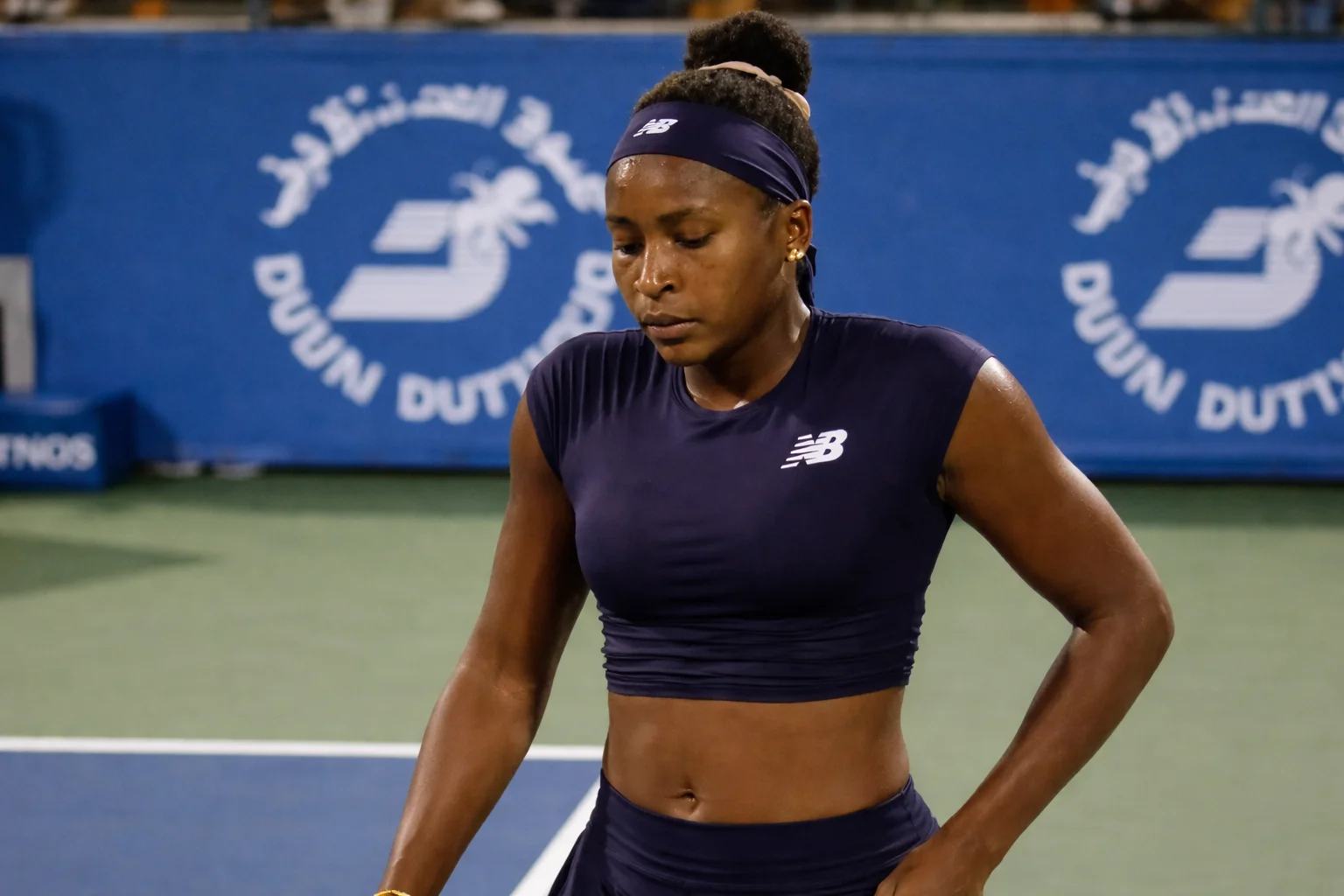

Coco Gauff has spent years searching for a way to make Miami feel like hers. This week, she has finally found it.
The 21-year-old arrives at her first Miami Open final not as a passenger of expectation, but as a player who has negotiated her way through discomfort, momentum swings and the weight of playing at home. Waiting on the other side is Aryna Sabalenka — the most consistent force of the swing, and a player with a far cleaner route to this point.
Gauff turns a problem tournament into an opportunity
There has always been something slightly uneasy about Gauff’s relationship with Miami.
For all her success elsewhere, this tournament resisted her. Six appearances, no quarter-finals, and a win percentage that sat awkwardly among her WTA 1000 results. It never quite clicked.
Until now.
This run has not been smooth, but it has been revealing. Three consecutive three-set wins early in the tournament told a familiar story — slow starts, fluctuating control, and the need to recover ground. Against Elisabetta Cocciaretto and Alycia Parks, she had to come from a set down. Against Sorana Cîrstea, even a lead did not simplify matters.
Yet there has been a shift.
Rather than letting matches drift away, Gauff has managed them. The win over Belinda Bencic carried the same tension — a strong opening set, a drop, then a reset — but crucially, she found solutions rather than spiralling.
Then came the semi-final.
Her 6-1, 6-1 win over Karolina Muchova was not just her best performance of the week, it was her cleanest. For once, the match stayed within her control from start to finish. The serve held up, the court coverage imposed itself, and the decision-making — often the first thing to waver — remained sharp.
It was the version of Gauff that tends to win titles.
Sabalenka arrives with clarity and control
If Gauff’s route has been shaped by adaptation, Sabalenka’s has been defined by clarity.
The world No. 1 has moved through Miami without conceding a set, and with minimal disruption. From a testing opener against Ann Li to controlled wins over Caty McNally and Zheng Qinwen, the pattern has remained consistent: high first-serve efficiency, short points, and steady scoreboard pressure.
The deeper rounds followed the same script.
She handled Hailey Baptiste without allowing the match to stretch, then dismissed Elena Rybakina in straight sets — a result that carried more weight given their recent history. Where previous meetings have tilted, this one stayed firmly in Sabalenka’s control.
Across Indian Wells and Miami, she has dropped just one set.
This is not streaky form. It is sustained command.
A final balanced by contrast
On paper, the contrast is straightforward.
Sabalenka has been the more efficient player, spending less time on court and exerting control from the first ball. Gauff has had to work harder, navigating longer matches and more volatile patterns.
In practice, it is less clear.
The head-to-head sits at 6-6, reflecting a rivalry that rarely settles into one direction. Gauff has shown she can disrupt Sabalenka’s rhythm, particularly when she extends rallies and absorbs pace. Sabalenka, meanwhile, has the ability to shorten exchanges and remove that dynamic entirely.
The question is not who is better — it is who imposes their version of the match.
Stakes framed by timing
For Gauff, the significance is immediate.
A title in Miami would reshape a tournament that has long sat awkwardly in her schedule. It would also provide a degree of insulation heading into the clay swing, where she carries heavy points from last season.
For Sabalenka, the frame is broader.
A win would complete the Sunshine Double — a rare achievement that places her alongside Graf, Clijsters, Azarenka and Swiatek. It would also confirm a level of consistency that has defined the opening months of her season.
One match, two narratives
Gauff has arrived here by learning how to steady herself within matches.
Sabalenka has arrived by removing instability altogether.
The final sits somewhere between those two ideas — control versus recovery, clarity versus adjustment. The margins, as they have been throughout the tournament, are likely to be small.
But for Gauff, this is no longer unfamiliar ground.
It is finally her moment in Miami.
In Sabalenka, a wall awaits.
Our bold prediction: Sabalenka won’t let this one slip.