
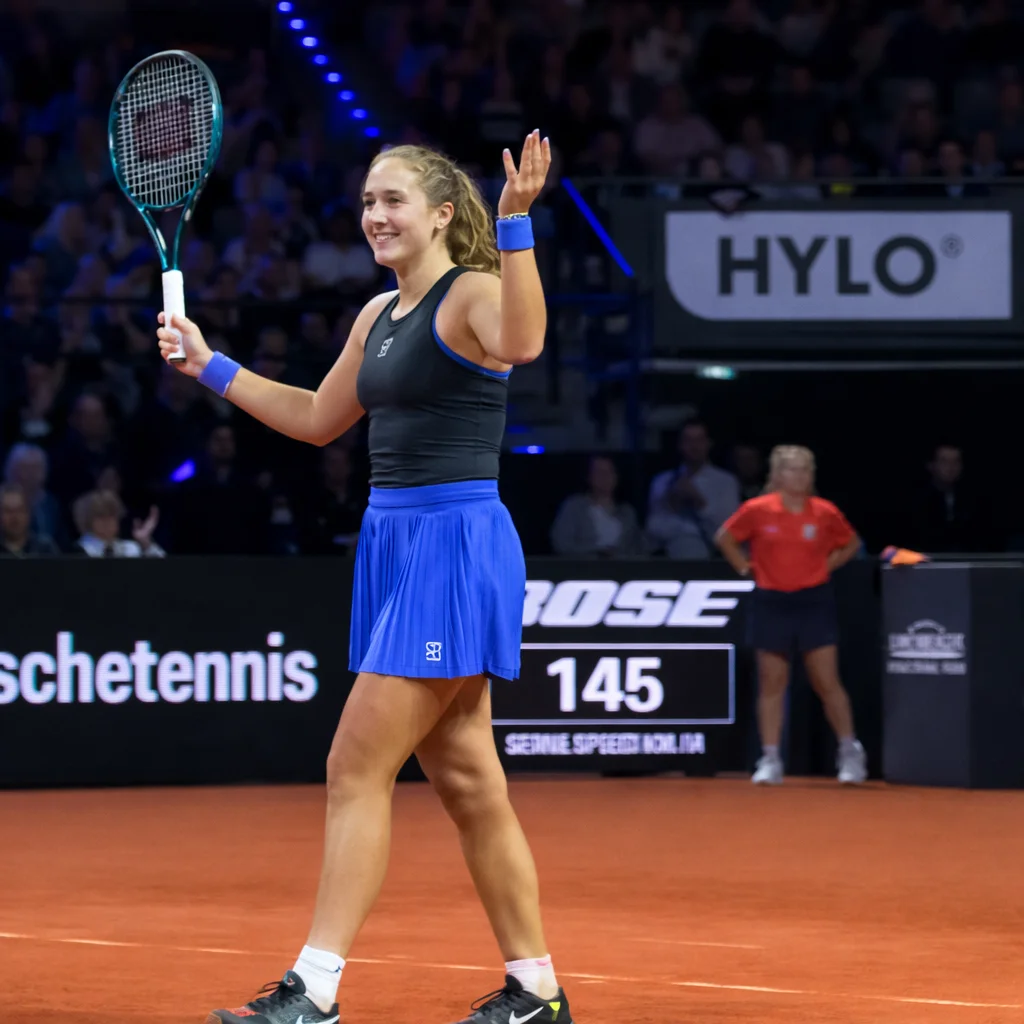
Mirra Andreeva’s Stuttgart campaign began on a knife edge—and turned on nerve. The No. 6 seed recovered from both a set down and a 1–4 deficit in the decider to defeat Jelena Ostapenko 5–7, 6–2, 6–4, producing one of the most controlled comebacks of the opening round.
For long stretches, this was played on Ostapenko’s terms. But when the match tightened, it was Andreeva who held her shape.
A first set that slipped away
The opening set followed a delicate balance, with Andreeva initially appearing the more settled of the two. She created the first real separation, breaking and consolidating to move ahead, while Ostapenko oscillated between clean winners and frustration.
At 5–5, there was still no clear edge.
Then came the swing. Serving at 5–6, Andreeva led 40–0—three points from forcing a tiebreak. What followed was a collapse of control. Ostapenko steadied from the baseline, extended rallies just enough, and capitalised as errors crept in.
Five points later, the set was gone.
Reset and response
To her credit, Andreeva did not carry that moment into the second set. She reset immediately, breaking early and backing it up with a series of composed service games.
The difference lay in clarity. Points were shorter, decisions firmer, and Ostapenko was denied the rhythm she thrives on. From 0–1, Andreeva surged through the set, building a 4–1 lead and closing it out with minimal resistance.
At one set all, the match felt level again—but the momentum had shifted.
Ostapenko strikes first in the decider
The third set, however, seemed to swing back just as quickly. Ostapenko reasserted herself, breaking for 3–1 and then holding confidently to extend the gap to 4–1.
Her aggression returned, and for a moment the finish looked inevitable.
Andreeva, though, refused to let it run.
Five games that changed everything
The turning point came through the second serve. Andreeva stepped in, attacked with intent, and broke back to stay alive at 3–4.
From there, the pattern reversed entirely.
She held, levelled, and then surged ahead, stringing together five consecutive games in a run that combined patience with precision. Where Ostapenko had dictated earlier, she now began to press—errors creeping back in as the match tightened.
At 5–4, Andreeva served for it.
This time, there was no hesitation.
Composure over chaos
The final stretch captured the contrast between the two. Ostapenko’s game remained high-risk, searching for quick resolution. Andreeva, by contrast, absorbed, redirected, and waited for the right moment.
It was not her cleanest match—but it was one of her most mature.
From 1–4 down in the deciding set, she did not chase the match. She managed it.
Jelena Ostapenko vs Mirra Andreeva – Match Stats
| Statistic | Jelena Ostapenko | Mirra Andreeva |
|---|---|---|
| Dominance Ratio | 0.93 | 1.07 |
| Winners | 48 | 29 |
| Unforced Errors | 62 | 37 |
| Serve Rating | 206 | 223 |
| Aces | 4 | 11 |
| Double Faults | 6 | 10 |
| 1st Serve % | 67% (61/91) | 57% (66/115) |
| 1st Serve Points Won | 57% (35/61) | 64% (42/66) |
| 2nd Serve Points Won | 37% (11/30) | 41% (20/49) |
| Break Points Saved | 22% (2/9) | 58% (7/12) |
| Service Games | 53% (8/15) | 67% (10/15) |
| Ace % | 4.4% | 9.6% |
| Double Fault % | 6.6% | 8.7% |
| Return Rating | 170 | 231 |
| 1st Return Points Won | 36% (24/66) | 43% (26/61) |
| 2nd Return Points Won | 59% (29/49) | 63% (19/30) |
| Break Points Won | 42% (5/12) | 78% (7/9) |
| Return Games | 33% (5/15) | 47% (7/15) |
| Pressure Points | 33% (7/21) | 67% (14/21) |
| Service Points | 51% (46/91) | 54% (62/115) |
| Return Points | 46% (53/115) | 49% (45/91) |
| Total Points | 48% (99/206) | 52% (107/206) |
| Match Duration | 2h22m | |
A test passed
The reward is a place in the second round in Stuttgart, where qualifier Alycia Parks awaits—arriving with three straight-set wins of her own.
For Andreeva, though, this was the real examination.
Not of level, but of control. And in a match that threatened to slip twice, she found just enough of it.